
Microtomus luctuosus
(Stål, 1854)
Tamaulipan White-winged Assassin
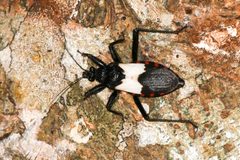
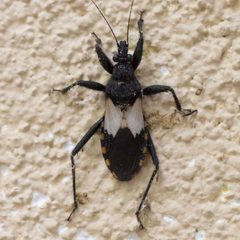
Microtomus luctuosus is a of assassin bug in the Reduviidae, native to the Americas. It belongs to the Hammacerinae, which includes species commonly known as bark assassin bugs. The species has been recorded across a broad geographic range spanning North, Central, and South America. Like other members of its , it is likely associated with woodland and cryptic microhabitats such as beneath bark. The specific epithet 'luctuosus' (Latin for 'mournful' or 'sorrowful') may refer to its coloration.
Pronunciation
How to pronounce Microtomus luctuosus: /ˌmaɪ.kɹoʊˈtoʊ.məs lʌkˈtjuː.oʊ.səs/
These audio files are automatically generated. While they are not always 100% accurate, they are a good starting point.
Identification
Microtomus luctuosus can be distinguished from by specific morphological features, though detailed diagnostic characters are not well documented in accessible literature. The Microtomus is characterized by relatively elongate body form compared to some other reduviid genera. Accurate identification to level typically requires examination of genitalic structures and comparison with . It may be confused with Microtomus purcis, which occurs in eastern North America and is known for its striking black, white, and red coloration; however, M. luctuosus has a more southerly and westerly distribution.
Images
Habitat
Based on records for the and , M. luctuosus likely inhabits dry-mesic to mesic woodland environments. Congeneric such as M. purcis are documented from upland oak-hickory and oak-pine forests, particularly in association with standing dead trees with loose bark. The species probably utilizes cryptic microhabitats including beneath bark and in tree cavities.
Distribution
Recorded from North America, Central America, and South America. Specific documented localities include the southwestern United States (including Texas), Mexico, and regions further south. The 'Tamaulipan White-winged Assassin' suggests association with the Tamaulipan biotic province spanning northeastern Mexico and southern Texas.
Ecological Role
As a member of Reduviidae, M. luctuosus functions as a in forest . Assassin bugs in this ecological guild contribute to regulation of of other arthropods, including potential pest . The Microtomus, with its bark-dwelling habits, likely occupies a specialized predatory in the dead wood .
Human Relevance
Direct interactions with humans are poorly documented. Some assassin bugs can deliver painful defensive bites when handled, though no specific reports for M. luctuosus were found. The has no documented economic importance as either pest or beneficial insect in agriculture.
Similar Taxa
- Microtomus purcisSimilar size and bark-dwelling habits, but M. purcis has distinctive black, white, and red coloration and is restricted to eastern North America, primarily in the Ozark Highlands and adjacent regions.
- Arilus cristatusBoth are large, conspicuous reduviids, but A. cristatus (wheel bug) has a prominent wheel-like crest on the pronotum and is more widely distributed across eastern North America.
More Details
Taxonomic note
The was originally described by Carl Stål in 1854. It is classified in the Hammacerinae, a group sometimes referred to as 'bark assassin bugs' for their habit of sheltering beneath loose bark. The Microtomus currently contains approximately 20 described species, primarily distributed in the New World tropics and subtropics.
Data limitations
Published natural history information specific to M. luctuosus is sparse. Most available information derives from -level or -level treatments, or from studies of . Field observations and targeted studies are needed to document preferences, seasonal activity, and ecological relationships.