
Dictyla echii
(Schrank, 1781)
Bugloss Lace Bug
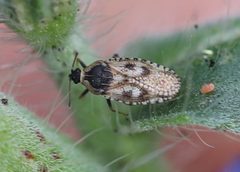
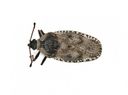
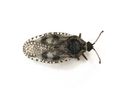
A lace bug (Hemiptera: Tingidae) native to the Palearctic and introduced to North America. In Canada, it is and overwinters as in soil near plant rosettes in reproductive . In the Mediterranean region, it produces at least 2–3 annually. Associated primarily with Boraginaceae, especially Echium . Tested as a agent for Echium plantagineum () in Australia but rejected due to insufficient host specificity.
Pronunciation
How to pronounce Dictyla echii: //ˈdɪk.tɪ.lə ˈɛ.kɪ.aɪ//
These audio files are automatically generated. While they are not always 100% accurate, they are a good starting point.
Identification
and stages described and illustrated in Canadian studies; specific diagnostic characters not detailed in available sources. Distinguished from Dictyla nassata by climatic preference—D. echii tolerates cooler conditions while D. nassata requires warmer climates, allowing coexistence in Portugal with minimal direct competition. Three recognized: D. e. echii, D. e. nigricans, and D. e. rufina.
Images
Habitat
Soil near plant rosettes for ; tender green stems and upper leaf surfaces of host plants for oviposition and feeding. In Canada, found in southwestern Québec and southeastern Ontario. In Europe, common in Mediterranean region.
Distribution
Native: Europe, Northern Asia (excluding China), Southern Asia, Africa. Introduced: North America (northeastern United States, Canada—Québec, Ontario).
Seasonality
In Canada: , with active after . In Mediterranean region: at least 2–3 per year.
Diet
Oligophagous within Boraginaceae. Feeds on rosettes, stems, and flower shoots of Echium vulgare and Echium plantagineum. specificity testing confirmed feeding on multiple Australian native Boraginaceae .
Host Associations
- Echium vulgare - primary Associated with this in Canada; inserted in stems, and nymphs feed on rosettes, stems, and flower shoots
- Echium plantagineum - ; primary target for testing
- Australian native Boraginaceae - Multiple attacked during specificity testing, leading to rejection as agent
Life Cycle
Apparently in Canada; overwinter in soil near rosettes in reproductive . At least 2–3 per year in Mediterranean region. develop in before deposition; studied. Eggs almost entirely inserted into tender green stems, rarely into upper leaf surface tissue. Hatching and first instar described.
Behavior
Feeding causes chlorotic appearance of foliage and stunted floral shoots. Can reduce or prevent seed formation through depigmentation and destruction of leaf and mesophyll . Mating and oviposition site selection studied in Canadian .
Ecological Role
Herbivore on Boraginaceae. Potential agent for Echium plantagineum, though rejected due to oligophagy extending to native Boraginaceae. Coexists with Dictyla nassata in Portugal with minimal direct due to differential climatic requirements.
Human Relevance
Evaluated as agent for (Echium plantagineum), an weed in Australia. Testing abandoned before completion due to insufficient specificity— attacks multiple native Australian Boraginaceae.
Similar Taxa
- Dictyla nassataCo-occurs with D. echii in Portugal; distinguished by warmer climatic requirements and for different thermal regimes, allowing partitioning with minimal competition
- Other Dictyla species-level similarity in and ; specific diagnostic features for D. echii not detailed in available sources
Sources and further reading
- BugGuide
- Wikipedia
- GBIF taxonomy match
- iNaturalist taxon
- NCBI Taxonomy
- Catalogue of Life
- Just Hovering | Bug Squad
- Bug Squad
- Natural history of Dictyla echii (Hemiptera: Tingidae) in Ontario and Québec, Canada
- Host specificity of the two lace bugs,Dictyla echii andDictyla nassata [Hem.: Tingidae] potential biological control agents for paterson's curse (Echium plantagineum)
- Life histories and host specificities of theEchium bugsDictyla echii andDictyla nassata [Hem.: Tingidae]