
Spissistilus
Caldwell, 1949
Three-cornered alfalfa hopper (for S. festinus)
Species Guides
6Spissistilus is a of treehoppers ( Membracidae) native to North and Central America and the West Indies. The genus was erected by John S. Caldwell in 1949, with Membracis festina (now Spissistilus festinus) as the type . The genus contains eight recognized species, with S. festinus being the most economically significant due to its status as a major agricultural pest.
Pronunciation
How to pronounce Spissistilus: //ˌspɪsɪsˈtaɪləs//
These audio files are automatically generated. While they are not always 100% accurate, they are a good starting point.
Identification
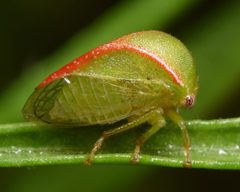
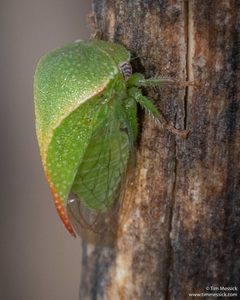
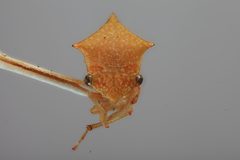
Members of Spissistilus can be distinguished from other by their placement in the tribe Ceresini. The genus is characterized by with triangular or wedge-shaped pronota. Spissistilus festinus specifically exhibits a distinct three-cornered appearance when viewed from the front, with one corner at each "shoulder" and one at the apex of the pronotum. The two recognized of S. festinus differ morphologically in pronotum elevation, with California specimens showing a less elevated pronotum than southeastern U.S. specimens.
Images
Habitat
Agricultural and natural vegetation systems including alfalfa fields, soybean fields, peanut fields, vineyards, pastures, and associated weed . In vineyard , are supported by Fabaceae cover crops and native vegetation in understories and adjacent .
Distribution
Native to North America, Central America, and the West Indies. Documented in the United States from California, Arizona, Louisiana, Texas, Florida, South Carolina, Kansas, Mississippi, Missouri, and Hawaii. Also recorded in Mexico. Two distinct occur: one in California and Arizona, and another in the southeastern United States.
Seasonality
are present year-round in alfalfa fields and pastures in southern regions, with peaking in fall. In California vineyards, adults migrate into vineyards in late winter during grapevine dormancy to feed and reproduce on cover crops and weed . Multiple occur per year in southern regions.
Diet
Phloem-feeding on vascular plants. Documented include alfalfa (Medicago sativa), soybean (Glycine max), peanut (Arachis hypogaea), grapevine (Vitis vinifera), snap bean (Phaseolus vulgaris), cowpea, sweet clover, tomato, melon, wheat, oats, Bermuda grass, and Johnson grass. Feeding occurs preferentially on petioles and stems.
Host Associations
- Medicago sativa - preferred feeding and reproductive alfalfa
- Glycine max - major crop soybean
- Arachis hypogaea - crop peanut
- Vitis vinifera - reproductive and virus transmission hostgrapevine; not preferred for feeding but supports
- Phaseolus vulgaris - laboratory rearing snap bean; supports all life stages
- various Asteraceae - natural vegetation identified from gut content analysis in Napa Valley
- various Fabaceae - cover crop and natural vegetation common in vineyard understories
Life Cycle
Overwinters as outside crop fields. are laid in plant stems, with oviposition occurring on preblooming . Nymphs progress through five instars before molting into winged adults. Nymphal development and survival are temperature-dependent. First through third instars are relatively immobile and difficult to detect with sweep nets; fourth and fifth instars and adults are more readily sampled. In California vineyards, a model has been developed to predict early instar presence for timing cultural control measures.
Behavior
are highly mobile and capable of landscape-level movement with estimated travel distances up to 2 km. Both adults and nymphs exhibit girdling , creating rings of punctures around stem circumferences that interrupt nutrient flow and cause stem breakage. Nymphs show cryptic behavior. Males produce -specific vibrational signals for mate attraction and courtship coordination. Adults aggregate socially on plants, with preference for petiole feeding sites. Feeding behavior induces nutrient accumulation above girdle sites, with increasing more than 12-fold in affected stem sections.
Ecological Role
Agricultural pest causing direct damage through phloem feeding and stem girdling. Documented of grapevine red blotch-associated virus (GRBaV), transmitting the virus to healthy grapevines. Serves as prey for hemipteran and ants. for fungal Erynia delphacis. Functions as a connector between natural vegetation and agricultural systems through landscape-level and mixed feeding on native plants and crops.
Human Relevance
Major economic pest of alfalfa, soybean, and peanut in the southern United States. Recently identified as the first confirmed of grapevine red blotch virus, a significant threat to the wine grape industry worth $162 billion globally. Virus transmission by S. festinus can reduce grape quality, brix, and wine quality. Management strategies include scouting, ground cover removal through discing, adjustment of seeding rates, and timing of cultural practices using models. for management remain unclear for some crops, leading to preventive applications.
Similar Taxa
- Other Membracidae generaSpissistilus belongs to tribe Ceresini, distinguishing it from treehoppers in other tribes; other Ceresini lack the distinct three-cornered pronotal shape of S. festinus
- CeresaRelated in tribe Ceresini; Spissistilus differs in specific pronotal and associations
More Details
Genetic diversity
Two distinct of S. festinus occur in the United States, separated by up to 10.8% in the mitochondrial COI gene. The California/Arizona genotype differs from the southeastern U.S. genotype in pronotum elevation and can be distinguished by a diagnostic assay.
Reproductive biology
Females are synovigenic, emerging as prior to initiation of , and undergo multiple rounds of production. Gravid females have been observed from February through November in California.
Virus transmission
S. festinus transmits grapevine red blotch-associated virus (GRBaV) horizontally but not vertically (transovarially). Transmission varies by virus isolate, , and sex of the .
Nutritional ecology
Girdling creates nutrient sinks that attract subsequent feeding, with asparagine and proline increasing 40- and 60-fold respectively in affected stem sections. This can lead to formation of new girdles within 10 mm of original damage.
Sources and further reading
- BugGuide
- Wikipedia
- GBIF taxonomy match
- iNaturalist taxon
- NCBI Taxonomy
- Catalogue of Life
- Meet the Researchers and the Three-Cornered Alfalfa Hopper | Bug Squad
- A Bug That's Not Wanted in the Vineyards | Bug Squad
- Bugs and Beat: Talented UC Davis Graduate Students Form Insect-Themed Band | Bug Squad
- Soybean Insects: Early-to-Late Season Pests (Emergence to R7) - AgriLife Extension Entomology
- Crazy Eyes | Beetles In The Bush
- Get to Know the Threecornered Alfalfa Hopper, a (Maybe) Serious Crop Pest
- Three-cornered Alfalfa Hopper Spissistilus festinus (Say) (Insecta: Hemiptera: Membracidae)
- Role of Vibrational Signals in Mating Behavior of Spissistilus festinus (Homoptera: Membracidae)
- Feeding and Reproductive Hosts of Spissistilus festinus (Say) (Hemiptera: Membracidae) Found in Californian Vineyards
- Identification of Nonhost Cover Crops of the Three-Cornered Alfalfa Hopper (Spissistilus festinus)
- Vitis vinifera(Vitales: Vitaceae) as a Reproductive Host ofSpissistilus festinus(Hemiptera: Membracidae)
- Distribution of Eggs and Parasites of Lygus spp. (Hemiptera: Miridae), Nabis spp. (Hemiptera: Nabidae), and Spissistilus festinus (Say) (Homoptera: Membracidae) on Plant Stems
- Two Distinct Genotypes of Spissistilus festinus (Say, 1830) (Hemiptera, Membracidae) in the United States Revealed by Phylogenetic and Morphological Analyses
- HISTOLOGY OF ANOMALOUS GROWTH AND ADVENTITIOUS ROOTS ASSOCIATED WITH MAINSTEM GIRDLING BY THREECORNERED ALFALFA HOPPER, SPISSISTILUS FESTINUS (SAY) (HOMOPTERA: MEMBRACIDAE) ON SOYBEAN1
- Girdling‐induced nutrient accumulation in above ground tissue of peanuts and subsequent feeding by Spissistilus festinus, the three‐cornered alfalfa hopper
- Evaluation of Alfalfa Fields and Pastures as Sources ofSpissistilus festinus(Hemiptera: Membracidae): Quantification of Reproductive and Nutritional Parameters
- Timing the Implementation of Cultural Practices for Spissistilus festinus (Hemiptera: Membracidae) in California Vineyards Using a Stage-Structured Degree-Day Model
- Phylogeny of Geminivirus Coat Protein Sequences and Digital PCR Aid in Identifying Spissistilus festinus as a Vector of Grapevine red blotch-associated virus
- Use of Ground Covers to Control Three-Cornered Alfalfa Hopper, Spissistilus festinus (Hemiptera: Membracidae), and Other Suspected Vectors of Grapevine Red Blotch Virus
- Rearing of Spissistilus festinus [Say, 1830] (Hemiptera: Membracidae) on snap bean to facilitate studies on the transmission biology of grapevine red blotch virus
- Ecological Connectivity of Plant Communities for Red Blotch Disease Dynamics Revealed by the Dietary Profiles and Landscape-Level Movement of Spissistilus festinus
- Comparative Acquisition, Transmission, and Retention of Distinct Grapevine Red Blotch Virus Isolates in Relation to the Genotype and Sex of Spissistilus festinus, the Treehopper Vector.
- Lack of Vertical Transmission of Grapevine Red Blotch Virus by Spissistilus festinus and Sex-Associated Differences in Horizontal Transmission.