
Jikradia olitoria
(Say, 1831)
Coppery Leafhopper
Species Guides
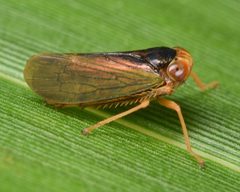
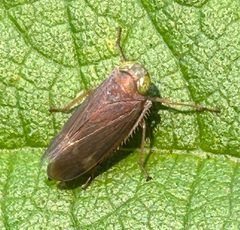
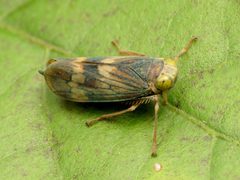
1Jikradia olitoria, commonly known as the Coppery Leafhopper, is a leafhopper in the Cicadellidae found primarily in eastern North America. It is a putative of the NAGYIIIβ phytoplasma strain associated with North American Grapevine Yellows, a destructive of grapevines. The species has been documented in Virginia vineyards and surrounding vegetation, with active from May through October. Laboratory studies have confirmed its ability to release phytoplasmas during phloem-feeding, though whole-plant transmission remains to be demonstrated.
Pronunciation
How to pronounce Jikradia olitoria: /dʒɪkˈreɪdiə oʊˈlɪtɔːriə/
These audio files are automatically generated. While they are not always 100% accurate, they are a good starting point.
Identification
Previously classified under the Coelidia, now placed in Jikradia. The can be distinguished from other Jikradia species by morphological characters associated with the genus transfer and subsequent taxonomic revisions. Specific diagnostic features for field identification are not documented in available sources.
Images
Habitat
Found in Virginia vineyards (Frederick, Fauquier, and Loudoun Counties) and surrounding mixed vegetation including scrub, forest, and deciduous woodland. Collected from grapevines, vineyard floor, vineyard headlands, and vegetation immediately outside vineyards. Vineyard edge appear particularly important for seasonal movement patterns.
Distribution
Eastern North America, with confirmed records from Virginia, southeast Pennsylvania, and the Yadkin Valley of North Carolina. Distribution records also include Alabama, Arizona, Arkansas, Connecticut, and Corsica (France), though the latter may represent vagrant or introduced occurrences. Core range appears centered in the eastern United States.
Seasonality
collected from May through October. Seasonal movement into vineyard edges observed during this period. Laboratory studies used insects collected across this active season.
Diet
Phloem-feeding on plants. Demonstrated probing of artificial diet solutions (5% sucrose Tris-EDTA) in laboratory assays. plants include Vitis vinifera (grapevine), Hordeum vulgare (barley), and Trifolium repens (white clover).
Host Associations
- Vitis vinifera - plantgrapevine; vineyard
- Hordeum vulgare - plantbarley
- Trifolium repens - plantwhite clover
- Clitemnestra bipunctata - preyparalyzed and stored as larval food by this sand wasp; recorded as Coelidia olitoria
Life Cycle
present May through October. Laboratory studies indicate a 21-day latency period required for leafhoppers to become inoculative (capable of transmitting phytoplasmas) following acquisition access period on infected plants. Specific details of , nymphal stages, and strategy are not documented.
Behavior
Seasonal movement from surrounding woodland and scrub vegetation into vineyard edges. Clustering of infected vines near vineyard edges suggests edge-mediated . Phloem-feeding behavior enables phytoplasma acquisition and transmission. Artificial feeding assays demonstrated release of phytoplasmas during feeding.
Ecological Role
Putative of 'Candidatus Phytoplasma pruni'-related NAGYIIIβ phytoplasma strains causing North American Grapevine Yellows. Potential vector linking wild and woodland vegetation to cultivated grapevines. Prey for the sand wasp Clitemnestra bipunctata, which paralyzes for larval provisioning.
Human Relevance
Agricultural pest of concern due to role as of North American Grapevine Yellows, a destructive of grapevines affecting vineyards in Virginia and neighboring regions since the 1980s. First evidence of phytoplasma vector capability was established through artificial feeding assays in 2018.
Similar Taxa
- Other Jikradia species require morphological examination for differentiation; this distinguished by historical taxonomic placement and association with Coelidia olitoria name
- Other Coelidiinae leafhoppers members share general ; specific identification requires examination of genitalia and other structural characters
More Details
Vector Research Significance
Jikradia olitoria was identified as the only insect out of 49 screened that released phytoplasmas into artificial feeding solutions in laboratory assays. This represented the first evidence of a potential insect for NAGY phytoplasmas and the first report of J. olitoria as a putative vector of a plant pathogenic phytoplasma. However, whole-plant transmission confirmation remains to be demonstrated.
Taxonomic History
Originally described as Coelidia olitoria by Say in 1831 (or 1830 per some sources), later transferred to Jikradia. The synonym Coelidia olitoria appears in older literature, including prey records for the sand wasp Clitemnestra bipunctata.
Study Limitations
competence studies were limited to artificial feeding assays rather than whole-plant transmission confirmation. No NAGYI-B strain transmission was detected in screening assays. Molecular confirmation of phytoplasma identity relied on sequencing of three genomic regions from over 1,950 feeding assays.
Sources and further reading
- BugGuide
- Wikipedia
- GBIF taxonomy match
- iNaturalist taxon
- NCBI Taxonomy
- Catalogue of Life
- Bug Eric: Wasp Wednesday: Clitemnestra bipunctata
- Jikradia olitoria([Hemiptera]:[Cicadellidae]) Transmits the Sequevar NAGYIIIβ Phytoplasma Strain Associated with North American Grapevine Yellows in Artificial Feeding Assays