
Oncometopia orbona
(Fabricius, 1798)
Broad-headed Sharpshooter
Oncometopia orbona, commonly known as the broad-headed , is a large leafhopper in the Cicadellidae. It feeds on xylem sap from plants, processing large volumes of nutrient-poor fluid and excreting the excess as honeydew—a that creates the phenomenon of 'raining trees.' The possesses distinctive white chalky brochosomes on its sides, used to powder -laying sites. It is a strong flier with excellent eyesight and serves as a for egg in the family Mymaridae.
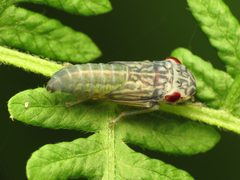
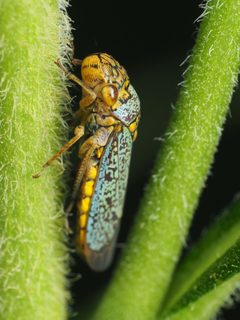
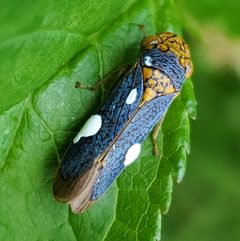
Pronunciation
How to pronounce Oncometopia orbona: /ˌɒŋkoʊmɪˈtoʊpiə ɔrˈboʊnə/
These audio files are automatically generated. While they are not always 100% accurate, they are a good starting point.
Identification
Large-bodied with a broad, somewhat flattened . Distinctive white chalky patches (brochosomes) visible on the lateral sides of the body. Overall coloration typically dark with possible greenish or brownish tones. Similar to Oncometopia nigricans, from which it may be distinguished by subtle morphological differences in color pattern and body proportions; definitive identification often requires examination of genitalia or expert taxonomic analysis.
Images
Habitat
Associated with trees and shrubs in various including urban areas, parks, and natural woodlands. Frequently found on shade trees where it feeds on xylem sap.
Distribution
Eastern and southeastern United States. Documented from Alabama, District of Columbia, Florida, Georgia, and Illinois.
Diet
Feeds exclusively on xylem sap from plants, obtained by inserting into vascular tissues. Must process large quantities of this nutrient-poor fluid to meet nutritional requirements.
Behavior
Forcefully excretes excess xylem fluid as honeydew droplets, creating visible 'rain' beneath infested trees. This honeydew production can be substantial enough to anoint surfaces below. Deposits brochosomes on -laying sites, possibly as protection against enemies or damaging substances. Strong flier with excellent eyesight; readily takes when disturbed.
Ecological Role
Contributes to nutrient cycling through honeydew production, which serves as a food source for other organisms. Acts as for (Mymaridae), providing a link in . Its feeding activity on xylem represents a distinctive trophic among herbivorous insects.
Human Relevance
Known for creating nuisance 'raining' conditions under infested trees due to honeydew . Can stain surfaces and create slippery conditions. Serves as a for agents targeting related pest sharpshooters.
Similar Taxa
- Oncometopia nigricansSimilar size, shape, and use; distinguished by subtle differences in coloration and body proportions, requiring close examination for separation.
- Homalodisca vitripennis (Glassy-winged Sharpshooter)Both are large Proconiini sharpshooters with similar xylem-feeding and honeydew production, though H. vitripennis has more elongated body form and different wing venation.