
Palingeniidae
spiny-headed burrowing mayflies
Genus Guides
1- Pentagenia(burrowing mayflies)
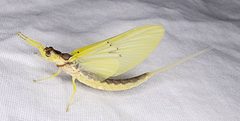
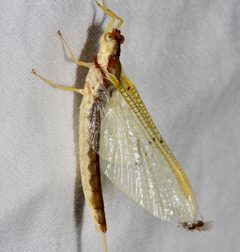
Palingeniidae is a of large mayflies commonly known as spiny-headed burrowing mayflies. are characterized by having more than four longitudinal cross- on their wings, with males possessing short, wide pronota and well-developed legs in both sexes. Female are shorter than the body. Nymphs are burrowers in muddy substrates of large rivers. The family includes notable such as Palingenia longicauda, the largest European at up to 12 cm in length.

Pronunciation
How to pronounce Palingeniidae: /ˌpælɪnˈdʒɛni.aɪdiː/
These audio files are automatically generated. While they are not always 100% accurate, they are a good starting point.
Identification
Distinguished from other by the combination of: more than four longitudinal cross- on wings; short, wide pronotum in males; well-developed legs in both sexes; and female shorter than the body. Nymphs are burrowing forms with adaptations for life in muddy sediments.
Images
Habitat
Large permanent lowland rivers and streams. Nymphs burrow in clayey or muddy sediments with particles exceeding 0.025–0.075 mm at the bottom of large water bodies.
Distribution
Europe: Tisza River system and tributaries, Rába River, Danube River (Hungary), Danube Delta (Romania, Ukraine), Prut River (Moldova, Romania), Mureș River, Bega River (Romania), Styr and Horyn' rivers (Northern Ukraine). Middle East: Euphrates–Tigris basin (Iraq), Karkheh River (Iran). Madagascar.
Life Cycle
Development includes , nymph, and stages. Male has been suggested in at least one (Mortogenesia), with preliminary evidence indicating missing adult and simultaneous occurrence of male subimagoes and females after oviposition.
Behavior
Nymphs are obligate burrowers in muddy river sediments, occurring at densities of approximately 100–200 individuals per square meter in suitable . are known for mass events.
Ecological Role
Nymphs function as benthic or collectors in large river systems, processing organic material in muddy substrates. Their burrowing activity may contribute to sediment bioturbation.
Human Relevance
Palingenia longicauda (Tisza ) is culturally significant in parts of Europe, where mass events have been historically celebrated. The underwent drastic range contraction due to 19th–20th century pollution and river modifications, with recent recovery in some areas attributed to water quality improvements following EU environmental directives.
Similar Taxa
- EphemeridaeBoth contain large burrowing mayflies with well-developed legs; Palingeniidae differs in wing venation (more than four longitudinal cross-) and male pronotum shape (short and wide versus other configurations)
- PolymitarcyidaeAnother of burrowing mayflies; Palingeniidae is distinguished by specific wing venation patterns and genitalic characteristics
Sources and further reading
- BugGuide
- Wikipedia
- GBIF taxonomy match
- iNaturalist taxon
- NCBI Taxonomy
- Catalogue of Life
- The larvae of the Madagascar genus Cheirogenesia Demoulin (Ephemeroptera: Palingeniidae)
- Description of larva, redescription of adults and biology of Mortogenesia mesopotamica (Morton, 1921) (Ephemeroptera: Palingeniidae)
- Cryptic survival and an unexpected recovery of the long-tailed mayfly Palingenia longicauda (Olivier, 1791) (Ephemeroptera: Palingeniidae) in Southeastern Europe