
Hexagenia limbata
(Serville, 1829)
Giant Mayfly, Golden Mayfly, Big Michigan Mayfly, Great Leadwing Drake, Fishfly
Hexagenia limbata is a large burrowing native to North America, widely distributed across lakes and slow-moving rivers. Nymphs construct U-shaped burrows in muddy substrates and serve as important prey for fish and other aquatic . emerge in synchronized mass events known as "hatches," living only 1–3 days without feeding, solely to mate and reproduce. The is economically significant to sport fishing and serves as a bioindicator of clean freshwater .
Pronunciation
How to pronounce Hexagenia limbata: /hɛkˈsædʒɪniə lɪmˈbɑːtə/
These audio files are automatically generated. While they are not always 100% accurate, they are a good starting point.
Identification
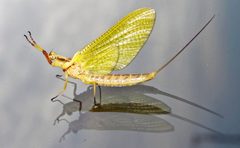
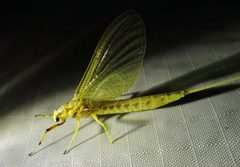
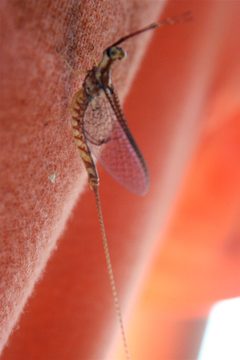
Distinguished from other North American mayflies by its large size, burrowing nymphal habit, and the combination of long forewings with much smaller hindwings bearing dark margins. The subimago stage (immediately post-) has cloudy wings rather than the clear wings of the mature . Nymphs can be identified by their U-shaped burrows in muddy substrates and the presence of tusk-like . Regional colloquial names ("," "golden ") may cause confusion with unrelated insects.
Images
Habitat
Lakes and slow-moving rivers with muddy or silty bottoms suitable for nymphal burrowing. congregate in swarms near water surfaces or rest in riparian vegetation. Nymphs require soft sediments (clay, silt, or sand-silt mixtures) for burrow construction; absent from hard substrates or fast-flowing waters.
Distribution
Widely distributed across North America. Present in most of Canada and all contiguous United States except Alaska and Arizona. Most abundant in the Great Lakes region. Documented from Ontario, Manitoba, Saskatchewan, and southward through the central and eastern United States.
Seasonality
occurs primarily in summer, typically June to August depending on latitude and water temperature. Peak emergence often in early July in northern . In cold northern lakes, the spans 2–3 years; in warm southern waters, development may complete in as little as 17 weeks. Mass emergence events are highly synchronized within populations but may vary geographically.
Diet
Nymphs are , feeding on organic particles transported into burrows by water currents generated by gill movements. lack functional mouthparts and do not feed.
Life Cycle
are laid on water surface and sink to bottom; many overwinter and hatch in spring. Nymphs construct U-shaped burrows in sediments and develop through up to 30 instars. Fully developed nymphs rise to surface, emerge as subimagos (winged but sexually , with cloudy wings), then once more to become reproductive imagos within 1–3 days. live briefly, mate, and die without feeding. Total development time ranges from 17 weeks in warm southern waters to 4 years in cold northern .
Behavior
Nymphs remain in burrows until fully developed, ventilating their burrows with abdominal gill movements. is highly synchronized, producing massive swarms that maximize mating probability. are attracted to artificial light at night, sometimes causing hazardous accumulations on roads and bridges. Subimagos to imagos at resting sites away from water.
Ecological Role
Nymphs are significant secondary producers and , linking organic matter to higher . They serve as critical prey for fish (especially during ), nymphs, birds, and amphibians. Mass emergence events provide seasonal nutrient pulses to terrestrial and aquatic . The is an indicator of clean, well-oxygenated freshwater .
Human Relevance
Economically important to sport fishing; and nymphal stages are mimicked by artificial flies. Mass emergences can create nuisance conditions near the Great Lakes, including slippery road surfaces, accumulation of carcasses, and distinctive odors (leading to the regional name ""). Attracted to lights, causing swarms at gas stations and on bridges. Hatches are detectable on weather radar. Celebrated at the Bay-Rama Fishfly Festival in Michigan.
Similar Taxa
- Hexagenia rigidaCo-occurs in similar ; distinguished by subtle morphological differences in nymphal and structures, often requiring expert identification.
- Ephemera simulansAnother burrowing in Ephemeridae; differs in distribution, timing, and subtle wing and body proportions.
Misconceptions
The "" in the Great Lakes region causes confusion with true fishflies ( Corydalidae, order Megaloptera), which are unrelated insects. The name "" is misleading as of this often emerge in June–July rather than May, and the group is not true flies (order Diptera).
More Details
Population Biology
Studies indicate occurs primarily during the nymphal stage in aquatic environments. -dependent factors affect growth rates.
Developmental Plasticity
Development time varies dramatically with thermal regime: 2–4 years in cold northern lakes versus less than one year in warm southern waters. accumulation in the final year before predicts timing better than total degree-days across the entire .
Cadmium Tolerance
Laboratory studies found no significant behavioral effects of sedimentary cadmium at concentrations typical of smelter-impacted lakes, suggesting relative to this metal.
Sources and further reading
- BugGuide
- Wikipedia
- GBIF taxonomy match
- iNaturalist taxon
- NCBI Taxonomy
- Catalogue of Life
- How to Survive a Massive Mayfly Swarm
- Teach a Man to Fish (and some entomology) and You’ll Feed Him for a Lifetime
- Cicindela limbata – epilogue | Beetles In The Bush
- Population Dynamics of the Burrowing Mayfly Hexagenia Limbata
- Reproduction of the Burrowing Mayfly, Hexagenia limbata (Serville), in Michigan
- Production ecology of Hexagenia limbata in Savanne Lake, Ontario
- Effect of sedimentary cadmium on the behavior of a burrowing mayfly (Ephemeroptera, Hexagenia limbata)
- Life Cycle of a Mayfly Hexagenia Limbata in the St. Marys River Between Lakes Superior and Huron
- Life histories of burrowing mayflies (Hexagenia limbata and H. rigida, Ephemeroptera: Ephemeridae) in a northern Canadian reservoir
- Life History and Productivity of Hexagenia limbata (Ephemeroptera: Ephemeridae) and Selected Physico-Chemical Parameters in Two Tributaries of the Wekiva River, Central Florida
- Spatial and temporal variation in the distribution of burrowing mayfly nymphs (Ephemeroptera: Hexagenia limbata and H. rigida) in western Lake Erie
- A Long-Term Study on the Population Biology of Crepidostomum cooperi (Trematoda: Allocreadidae) in the Burrowing Mayfly, Hexagenia limbata (Ephemeroptera)
- Production of Hexagenia limbata (Serville) and Ephemera simulans Walker (Ephemeroptera) in Dauphin Lake, Manitoba, with a Note on Weight Loss due to Preservatives
- Characterizing Hox genes in mayflies (Ephemeroptera), with Hexagenia limbata as a new mayfly model.