
Hexagenia
Walsh, 1863
giant mayflies, burrowing mayflies, fishflies
Species Guides
5- Hexagenia atrocaudata(Lake Hex)
- Hexagenia bilineata(Emergent Mayfly)
- Hexagenia limbata(Giant Mayfly)
- Hexagenia orlando(Florida Hex)
- Hexagenia rigida(Great Olive-winged Drake)
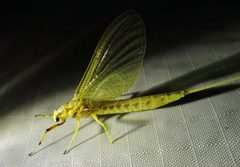
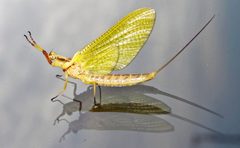
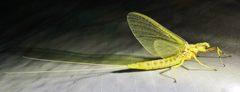
Hexagenia is a of large burrowing mayflies in the Ephemeridae, comprising eight recognized . Nymphs construct distinctive U-shaped, ventilated burrows in soft aquatic sediments of lakes, streams, and ponds. are notable for their synchronous mass emergences, which can produce swarms dense enough to appear on weather radar. The genus serves as an important bioindicator of water quality due to its intolerance of pollution and anoxia.
Pronunciation
How to pronounce Hexagenia: /hɛkˈsædʒɪniə/
These audio files are automatically generated. While they are not always 100% accurate, they are a good starting point.
Identification
Distinguished from other by the combination of: large body size (giant mayflies), U-shaped burrow construction , two tusk-like projections in nymphs, and presence of only two tails in versus three in nymphs. Mass synchronous emergences and attraction to lights are behavioral indicators. Differentiation from other Ephemeridae genera requires examination of genitalia and wing venation details.
Images
Habitat
Aquatic environments with soft substrates: silt, clay, or fine sand bottoms of lakes, ponds, streams, and slow-moving river sections (lotic-depositional areas). Intolerant of pollution and low oxygen conditions. Nymphs require substrates suitable for burrow construction; different show preferences for specific substrate types.
Distribution
Primarily northern United States and southern Canada; range extends south to Florida, northern Mexico, and Central America. Scattered reports from South America (Argentina) and Asia (India, Mongolia) may represent misidentifications. Historically abundant in Great Lakes and Mississippi River systems; have declined significantly in some areas since 2010.
Seasonality
Nymphal stage lasts 1–2 years (up to 4 years in colder regions). Mass emergences occur in late spring and early summer, often synchronized across . Subimago stage lasts less than 24 hours; stage similarly short-lived. Gravid females oviposit in evening hours.
Diet
Nymphs are , feeding on organic particulates and gathered from burrow walls or filtered from water pumped through burrows. lack functional mouthparts and do not feed.
Life Cycle
Hemimetabolous (). laid on water surface; nymphs aquatic, constructing U-shaped burrows. Nymphal development 1–4 years depending on temperature and region. : nymphs swim to surface, to subimago, fly to resting perch, molt again to within 24 hours. mate in swarms above water; females oviposit by rebounding off water surface.
Behavior
Nymphs undulate bodies within burrows to pump oxygenated water and food particles through their shelters. exhibit synchronous mass emergences, forming dense mating swarms. Strongly attracted to artificial light sources. Gravid females perform distinctive oviposition , repeatedly touching water surface to release while in .
Ecological Role
Critical trophic integrators linking detrital energy resources to fish . Nymphs serve as bioturbators, mixing lakebed sediments. Important prey for sturgeon, whitefish, cisco, goldeye, sauger, and trout. Presence indicates healthy, unpolluted aquatic ; absence or decline signals environmental degradation. Used as bioindicators for heavy metal pollution, microplastic , and eutrophication.
Human Relevance
Economically important to sport fishing: nymphs are preferred prey for many game fish; emergences trigger feeding frenzies. Fly fishing uses "hex patterns" to imitate Hexagenia limbata. Mass emergences can create hazardous driving conditions due to slippery road accumulations and reduced visibility. Swarms attracted to lights can overwhelm urban areas near water bodies. declines of 50–80% documented in western Lake Erie and Upper Mississippi River since 2010.
Similar Taxa
- EphemeraAlso burrowing mayflies in Ephemeridae; distinguished by differences in wing venation, genitalia, and burrow architecture
- LitobranchaAnother large burrowing ; separated by morphological details of nymphal tusks and genitalia
Misconceptions
Despite the "," Hexagenia are true mayflies (Ephemeroptera), not fishflies in the formal sense (which refers to Corydalidae in order Megaloptera). The name "" is also misleading as emergences often occur in June and July rather than May.
More Details
Population Status
Large- studies show significant declines in western Lake Erie and Upper Mississippi River since 2010. No special conservation status assigned to Hexagenia limbata or H. bilineata despite ecological importance and documented declines.
Research Significance
Standardized test organism for aquatic environmental monitoring. Artificial burrow protocols developed to reduce thigmotactic stress in laboratory testing, improving ecological relevance of toxicity data.
Sources and further reading
- BugGuide
- Wikipedia
- GBIF taxonomy match
- iNaturalist taxon
- NCBI Taxonomy
- Catalogue of Life
- Bug Eric: The Mayfly Analogy
- How to Survive a Massive Mayfly Swarm
- Teach a Man to Fish (and some entomology) and You’ll Feed Him for a Lifetime
- Eumastacidae | Beetles In The Bush
- Population Dynamics of the Burrowing Mayfly Hexagenia Limbata
- Burrowing mayflies (Hexagenia) as indicators of ecosystem health
- Substrate selection as a factor inHexageniadistribution
- Life history and secondary production ofHexagenia bilineata(Say) in an embayment of Kentucky Lake
- Factors Influencing the Distribution and Abundance of Hexagenia Nymphs (Ephemeroptera) in a Missouri River Reservoir
- Reproduction of the Burrowing Mayfly, Hexagenia limbata (Serville), in Michigan
- Methods for Using Nymphs of Burrowing Mayflies (Ephemeroptera, Hexagenia) as Toxicity Test Organisms
- Ecology of Hexagenia Naiads (Insecta-Ephemeridae) in an Oklahoma Reservoir
- A STUDY OF THE MAY FLIES (HEXAGENIA) OF LAKE WINNIPEG
- Effect of sedimentary cadmium on the behavior of a burrowing mayfly (Ephemeroptera, Hexagenia limbata)
- Role of artificial burrows inHexageniatoxicity tests: Recommendations for protocol development