
Hexagenia rigida
McDunnough, 1924
Great Olive-winged Drake
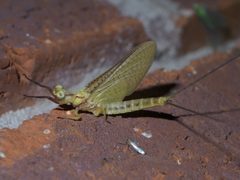
Hexagenia rigida is a burrowing (Ephemeroptera: Ephemeridae) native to North America. As a member of the common burrower mayfly , it spends most of its life as an aquatic nymph in lake and sediments, with emerging synchronously in large swarms. The has a multi-year , typically requiring 3-4 years to complete development from to adult in northern climates. Laboratory studies indicate that larval growth and mortality are significantly influenced by food availability and , with food limitation increasing size variation and mortality rates.
Pronunciation
How to pronounce Hexagenia rigida: /hɛk.səˈdʒiː.ni.ə ˈriː.dʒɪ.də/
These audio files are automatically generated. While they are not always 100% accurate, they are a good starting point.
Identification
Hexagenia rigida can be distinguished from the closely related and co-occurring H. limbata through examination of nymphal and size characteristics. Subimago size is strongly correlated with nymphal exuviae length, allowing field identification through collection of shed exuviae. Adults are medium to large mayflies with olive-colored wings (hence the "Great Olive-winged Drake"). The Hexagenia is characterized by burrowing nymphs with legs adapted for digging in sediments.
Images
Habitat
Aquatic; nymphs burrow in soft sediments of lakes, , and slow-moving waters. Found in bottom substrates of western Lake Erie and northern Canadian reservoirs. Laboratory rearing indicates preference for sediment substrates with detritus availability. Bottom temperatures in occupied range from 15-20°C during ice-free periods.
Distribution
North America; Nearctic region. Documented from western Lake Erie, northern Manitoba , and the Detroit River area near Windsor, Ontario. GBIF records indicate presence across the Nearctic region.
Seasonality
occurs during summer months; timing influenced by accumulation. In northern , emergence timing is better predicted by degree-day accumulation in the final year before emergence than by total degree-days over the entire .
Diet
Nymphs feed on detritus and diatoms in sediment substrates. Laboratory studies utilized these food sources for rearing. lack functional mouthparts and do not feed.
Life Cycle
Multi-year requiring 3 years in warmer regions and 4 years in cooler areas of northern Canada. Total accumulation (>10°C) to complete development ranges from 1222-1468. Nymphal development occurs in sediments; emerge synchronously in large swarms for mating. is strongly correlated with female body size.
Behavior
Nymphs exhibit burrowing in soft sediments. emerge in synchronous swarms ("hatches") for mating. Mass events can be extensive enough to appear on weather radar. Adults do not feed and have brief lifespans focused solely on .
Ecological Role
Important food source for fish, birds, amphibians, and other aquatic during events. Serves as a bioindicator of clean freshwater ; presence indicates healthy aquatic conditions. Used as a model organism for studying heavy metal bioaccumulation (cadmium, mercury) in aquatic environments.
Human Relevance
Significant for sport fishing; triggers feeding frenzies in trout and other game fish. Fly fishermen imitate the with artificial flies matching the "dun" (subimago) and "spinner" () stages. Mass emergence events can create nuisance conditions for lakeside , with swarms coating structures and roads.
Similar Taxa
- Hexagenia limbataCo-occurs in same (western Lake Erie, northern ) and shares burrowing lifestyle. H. limbata is more widely known and has similar characteristics, requiring careful examination of nymphal or size for differentiation.
Sources and further reading
- BugGuide
- GBIF taxonomy match
- iNaturalist taxon
- NCBI Taxonomy
- Catalogue of Life
- Bug Eric: The Mayfly Analogy
- How to Survive a Massive Mayfly Swarm
- Teach a Man to Fish (and some entomology) and You’ll Feed Him for a Lifetime
- 🌿 Botanizing w/ the WGNSS Botany Group at Victoria Glades Preserve | Beetles In The Bush
- pleasing fungus beetles | Beetles In The Bush
- Effects of density and food limitation on size variation and mortality of larval Hexagenia rigida (Ephemeroptera: Ephemeridae)
- Life histories of burrowing mayflies (Hexagenia limbata and H. rigida, Ephemeroptera: Ephemeridae) in a northern Canadian reservoir
- Spatial and temporal variation in the distribution of burrowing mayfly nymphs (Ephemeroptera: Hexagenia limbata and H. rigida) in western Lake Erie
- Fine-Scale Tissue Distribution of Cadmium, Inorganic Mercury, and Methylmercury in Nymphs of the Burrowing Mayfly Hexagenia rigida Studied by Whole-Body Autoradiography
- The first complete mitochondrial genome of Hexagenia rigida Mc Dunnough, 1924 (Ephemeroptera: Ephemeridae) and its phylogeny.