
Oligotomidae
Enderlein, 1909
webspinners
Genus Guides
2- Haploembia(webspinners)
- Oligotoma(webspinner)
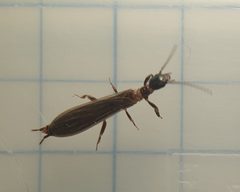
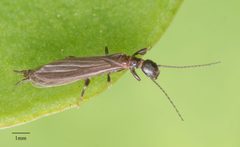
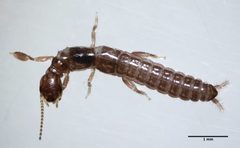
is a of webspinners (order ) comprising approximately 6 and at least 40 described . Members are characterized by silk-producing glands in the enlarged basal tarsomere of the forelegs, used to construct protective galleries. The family exhibits a predominantly Old World distribution with some introduced in the Americas. Notable genera include Oligotoma, Aposthonia, and Haploembia, with some species showing complex reproductive strategies including .
Pronunciation
How to pronounce Oligotomidae: /ˌɒlɪˈɡoʊtəmaɪdiː/
These audio files are automatically generated. While they are not always 100% accurate, they are a good starting point.
Identification
can be distinguished from other by the structure and arrangement of the silk-producing glands on the forelegs. Males typically possess wings and are more mobile, while females are usually and remain within silk galleries. Specific identification to or level requires examination of male genitalia and wing venation patterns. The genus Haploembia contains cryptic species that are difficult to distinguish morphologically and may require molecular analysis for definitive identification.
Images
Habitat
Tropical and subtropical regions; construct silken galleries in soil, leaf litter, bark crevices, and other protected microhabitats. The galleries provide shelter from desiccation and while enabling movement between feeding sites.
Distribution
Native to warmer regions of the Old World including South and Southeast Asia, the Indian Subcontinent, Australia, and parts of Africa. The Oligotoma has been introduced to the Southwestern United States and Mexico, with established across multiple Mexican states. Aposthonia ceylonica has been recorded in the United Kingdom as an introduced .
Diet
Plant debris
Life Cycle
Development includes , nymph, and stages. Nymphs possess functional silk glands and participate in gallery construction. Some within the Haploembia exhibit parthenogenetic , with females producing offspring without mating.
Behavior
Subsocial lifestyle with individuals living in communal silk galleries. Both sexes and all developmental stages produce silk from specialized glands located in the enlarged basal tarsomere of the forelegs. Silk is used to construct extensive tunnel systems that provide protection and facilitate movement. In Haploembia, antisocial has been observed as a distinguishing characteristic between cryptic , with parthenogenetic females showing less social than sexually reproducing counterparts.
Human Relevance
Generally inconspicuous due to concealed lifestyle; some have been introduced outside native ranges through human activity. Not considered economically significant pests or beneficial organisms. Aposthonia ceylonica detection in the UK in 2019 represents a notable range expansion for the .
Similar Taxa
- EmbiidaeAnother of webspinners distinguished by differences in wing venation, tarsal structure, and male genitalia; typically has simpler wing venation and distinct glandular structures on the forelegs.
- TeratembiidaeSmaller of webspinners with different geographic distribution and morphological characteristics including distinct pretarsal claw structure.
More Details
Molecular evolution
Comparative mitogenomic analysis of Aposthonia borneensis and A. japonica revealed divergent mitochondrial evolution with extensive rearrangements in A. japonica (18,305 ) versus a more conserved structure in A. borneensis (15,660 bp). divergence is estimated at approximately 103 million years ago, coinciding with Pangea breakup and geographic isolation between Japanese islands and continental southeastern Asia. This supports non-monophyly of the Aposthonia.
Reproductive diversity
The Haploembia includes both sexually reproducing (H. solieri) and parthenogenetic species (H. tarsalis), with the latter showing antisocial , larger size (1.44× ratio), and higher genetic variation within lineages.
Introduced species in Mexico
Three Oligotoma (O. humbertiana, O. nigra, O. saundersii) and Haploembia solieri are established in Mexico with expanding state-level distributions, representing successful Old World introductions to the New World.
Sources and further reading
- BugGuide
- Wikipedia
- GBIF taxonomy match
- iNaturalist taxon
- NCBI Taxonomy
- Catalogue of Life
- Aposthonia Krauss, 1911 (Embioptera: Oligotomidae) from Thailand, with description of a new species
- Comparative mitogenomic analysis of Aposthonia borneensis and Aposthonia japonica (Embioptera: Oligotomidae) reveals divergent evolution of webspinners
- Spinning behaviour and morphology of the spinning glands in male and female Aposthonia ceylonica (Enderlein, 1912) (Embioptera: Oligotomidae)
- Resolving two Haploembia (Embioptera: Oligotomidae) cryptic species: molecular data confirms parthenogenetic females can be distinguished by their antisocial behavior
- Fig 6 from: Moreno Castillo E, Dueñas-Cedillo AR, De Luna M, Pando-Moreno M, Garibay-Orijel R, Armendáriz-Toledano F, Cancino-López RJ (2026) The ignored of the soil: Current distribution and key to species of the introduced Old-World webspinners of the family Oligotomidae (Insecta, Embioptera) in Mexico. Journal of Orthoptera Research 35(1): 157-166. https://doi.org/10.3897/jor.35.154165
- The ignored of the soil: Current distribution and key to species of the introduced Old-World webspinners of the family Oligotomidae (Insecta, Embioptera) in Mexico
- Fig 1 from: Moreno Castillo E, Dueñas-Cedillo AR, De Luna M, Pando-Moreno M, Garibay-Orijel R, Armendáriz-Toledano F, Cancino-López RJ (2026) The ignored of the soil: Current distribution and key to species of the introduced Old-World webspinners of the family Oligotomidae (Insecta, Embioptera) in Mexico. Journal of Orthoptera Research 35(1): 157-166. https://doi.org/10.3897/jor.35.154165
- Fig 2 from: Moreno Castillo E, Dueñas-Cedillo AR, De Luna M, Pando-Moreno M, Garibay-Orijel R, Armendáriz-Toledano F, Cancino-López RJ (2026) The ignored of the soil: Current distribution and key to species of the introduced Old-World webspinners of the family Oligotomidae (Insecta, Embioptera) in Mexico. Journal of Orthoptera Research 35(1): 157-166. https://doi.org/10.3897/jor.35.154165
- Fig 3 from: Moreno Castillo E, Dueñas-Cedillo AR, De Luna M, Pando-Moreno M, Garibay-Orijel R, Armendáriz-Toledano F, Cancino-López RJ (2026) The ignored of the soil: Current distribution and key to species of the introduced Old-World webspinners of the family Oligotomidae (Insecta, Embioptera) in Mexico. Journal of Orthoptera Research 35(1): 157-166. https://doi.org/10.3897/jor.35.154165
- Fig 4 from: Moreno Castillo E, Dueñas-Cedillo AR, De Luna M, Pando-Moreno M, Garibay-Orijel R, Armendáriz-Toledano F, Cancino-López RJ (2026) The ignored of the soil: Current distribution and key to species of the introduced Old-World webspinners of the family Oligotomidae (Insecta, Embioptera) in Mexico. Journal of Orthoptera Research 35(1): 157-166. https://doi.org/10.3897/jor.35.154165
- Fig 5 from: Moreno Castillo E, Dueñas-Cedillo AR, De Luna M, Pando-Moreno M, Garibay-Orijel R, Armendáriz-Toledano F, Cancino-López RJ (2026) The ignored of the soil: Current distribution and key to species of the introduced Old-World webspinners of the family Oligotomidae (Insecta, Embioptera) in Mexico. Journal of Orthoptera Research 35(1): 157-166. https://doi.org/10.3897/jor.35.154165