
Oligotoma saundersii
(Westwood, 1837)
Saunders' embiid, Saunders' Webspinner
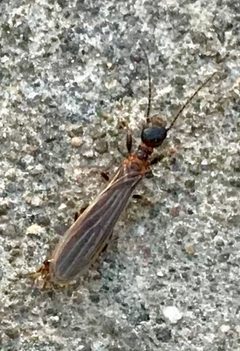
Oligotoma saundersii is a webspinner (order ) native to southern Asia that has become a widespread in tropical and subtropical regions worldwide. males possess long narrow wings and are attracted to lights at night, while females are flightless and chocolate-brown in color. The constructs silken galleries in concealed humid locations and has been introduced to the United States, where its range extends from Texas to Florida.
Pronunciation
How to pronounce Oligotoma saundersii: /ˌɒlɪɡəˈtoʊmə ˈsaʊndərzi/
These audio files are automatically generated. While they are not always 100% accurate, they are a good starting point.
Identification
Males distinguished from the similar Oligotoma nigra by the paler relative to the body. The enlarged, swollen of the front legs ('Popeye arms') separate webspinners from winged and small stoneflies. Females and nymphs are best identified by association with males, as they are difficult to distinguish from O. nigra. Males have wings that flip forward to avoid catching on silken gallery walls during backward movement.
Images
Appearance
males have long narrow wings and a dark brownish-black body with slight yellowish tinge, especially near limb joints; the is paler than the body. Adult females are flightless and chocolate-brown. Nymphs are much paler, yellowish-brown. Both sexes possess enlarged on the front legs containing approximately one hundred silk glands. Males are under 10 mm in length.
Habitat
Constructs silken tubes in concealed, humid microhabitats including crevices, under bark of trees, and similar sheltered locations. In laboratory settings, established colonies utilized large flakes of bark as retreat sites.
Distribution
Native to southern Asia; introduced and established in tropical and subtropical regions worldwide including the United States (Texas to Florida), Brazil (Amazon and Cerrado biomes, plus three states), and the Galápagos Islands. Spread has been facilitated by human activities.
Seasonality
Males have been observed at lights at night. In laboratory colonies, period to maturity was approximately four months; a second batch of larvae appeared approximately two months after male maturation.
Diet
Feeds on decaying vegetable matter. males do not feed.
Life Cycle
Females lay in silken tunnels; eggs are camouflaged within minutes by chewed substrate particles to resemble , possibly preventing . Eggs are not guarded by females. Galleries are expanded in anticipation of larval hatching. Development from egg to male observed at approximately four months in laboratory conditions.
Behavior
Constructs and inhabits silken galleries, remaining largely hidden and emerging primarily at night to feed. Moves quickly through silken tunnels, usually backwards. Males often remain half out of gallery openings during the day and may venture forth; females remain more concealed. Males are attracted to lights at night.
Ecological Role
Decomposer feeding on decaying vegetable matter. Serves as for including Sclerogibbid wasps (e.g., Probethylus schwarzi in Arizona).
Human Relevance
Non-pest occasionally found in human dwellings; frequently mistaken for winged . Spread to new regions has been facilitated by human transport, including introduction via date palm cuttings. Not considered economically significant.
Similar Taxa
- Oligotoma nigraFemales and nymphs are morphologically indistinguishable; males of O. saundersii identified by paler relative to body, whereas O. nigra males have more uniform dark coloration. Both have been introduced to the United States and occur in overlapping ranges.
- Winged termites (alates)Males frequently mistaken for due to similar size and winged appearance; distinguished by enlarged, silk-gland-bearing on front legs and forward-flipping wings adapted for backward movement in galleries.
Misconceptions
Frequently mistaken for by homeowners, causing unnecessary concern. Not a pest despite occasional indoor presence; does not damage structures or bite humans.
More Details
Silk production
The of the front pair of legs are enlarged and contain approximately one hundred silk glands, a diagnostic feature of the order . Even newly hatched nymphs can produce silk.
Colonial structure
Colonies typically consist of a parent female and her offspring in a matriarchal congregation, with galleries expanded as the colony grows.