
Oligotoma nigra
Hagen, 1885
black webspinner
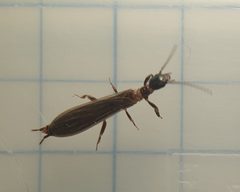
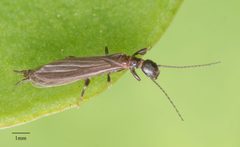
Oligotoma nigra, commonly known as the black webspinner, is a small silk-producing insect in the order . Native to India, it has been introduced to multiple regions including the southwestern United States, where it was likely transported via date palm cuttings in the late 1800s. The constructs extensive networks of silken tunnels under rocks, bark, and debris, spending nearly its entire life within these protective galleries. Only males possess wings and are capable of ; they are frequently attracted to lights at night.
Pronunciation
How to pronounce Oligotoma nigra: /ˌɒlɪˈɡoʊtəˌmaɪ ˈniːɡrə/
These audio files are automatically generated. While they are not always 100% accurate, they are a good starting point.
Identification
The combination of small size (under 10 mm), dark coloration, and especially the swollen foretarsal segments distinguishes Oligotoma nigra from superficially similar insects such as winged and small stoneflies. males at lights may be mistaken for termites, but the enlarged 'forearms' and ability to flip wings forward are diagnostic. The silken tunnel galleries are also characteristic of the order .
Images
Habitat
Occupies silken tunnel networks constructed beneath rocks, loose bark, leaf litter, and structural debris. In gardens, frequently associated with grass or ornamental plantings at the base. Often found near palm trees in invaded ranges. Requires proximity to food sources, with tunnels serving as both shelter and food storage.
Distribution
Native to India; introduced to Egypt, England, and the United States. In North America, established from Texas through California to Utah, covering much of the southwestern United States. Introduced to California (Davis area) within the last 5–10 years. Single records from Arkansas and possibly expanding.
Seasonality
typically completed within one year. males are attracted to lights at night, with activity patterns likely corresponding to warm seasons in temperate regions. Year-round activity probable in tropical and subtropical portions of range.
Diet
Feeds on decaying vegetable matter, including dead plant material, debris, mosses, and lichens. In gardens, observed feeding on grass and ornamental plants. males do not feed.
Life Cycle
Hemimetabolous (). are laid within silk tunnels. Nymphs hatch and immediately begin expanding the tunnel network, producing silk from glands on the basal foretarsal segments. Nymphs darken in color as they develop. Development from egg to typically completed within one year. The vast majority of the is spent within the protective silk tunnels.
Behavior
Constructs and inhabits extensive networks of silken tubes, moving rapidly through them—usually backwards. Nymphs and females rarely leave tunnels; males emerge to fly and seek mates. Silk production begins in early nymphal stages and continues throughout life. Social structure involves matriarchal congregations of a female parent and offspring sharing tunnel systems.
Ecological Role
Decomposer, processing dead plant material and contributing to nutrient cycling. Silk tunnel networks may modify microhabitat conditions beneath rocks and debris.
Human Relevance
Occasionally enters buildings when attracted to lights, causing minor concern due to resemblance to . Not a structural pest; does not damage buildings or stored products. Sometimes perceived as nuisance when males appear at lights in numbers. Misidentification as termites is common.
Similar Taxa
- alate termites (Isoptera/Blattodea) male O. nigra are frequently mistaken for winged due to similar size, dark wings, and attraction to lights. Distinguished by enlarged foretarsal segments (silk glands), body shape, and wing-folding .
- pink webspinner (unidentified species)Another introduced webspinner in California, known only from parthenogenic females. Does not appear at lights; more abundant under rocks and boards than O. nigra.
- small stoneflies (Plecoptera)Similar size and winged form may cause confusion, but stoneflies lack silk-producing forelegs and have different wing venation and body shape.
Misconceptions
Commonly mistaken for , leading to unnecessary concern about structural damage. Does not bite humans. Not a true pest despite occasional indoor appearances.
More Details
Introduction history
Likely introduced to North America in the late 1800s via shipping of date palm cuttings from the Persian Gulf region. Transported from Egypt and Persian Gulf to southwestern United States.
Silk production
Among the few insects with silk glands located on the legs rather than the or . This unique allows continuous silk production while moving through tunnels.
Taxonomic authority
Described by Hagen in 1885. The order has undergone name changes from to Embiidina and back; both appear in literature.