
Oligotoma
Westwood, 1837
webspinner
Species Guides
2- Oligotoma nigra(black webspinner)
- Oligotoma saundersii(Saunders' embiid)
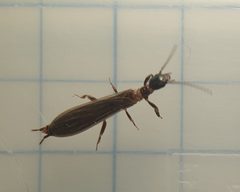
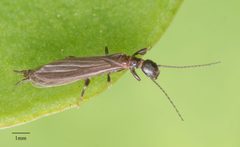
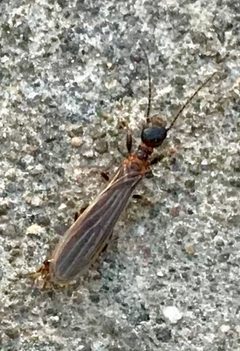
Oligotoma is a of webspinners in the Oligotomidae, characterized by pronounced : males are winged while females are flightless. Members possess enlarged front containing silk glands used to construct silken galleries and tubes. The type , Oligotoma saundersii, is native to the Indian subcontinent but has become worldwide, including in Brazil and the southwestern United States. Several species have been introduced to new regions through human commerce, notably in date palm cuttings.
Pronunciation
How to pronounce Oligotoma: /ˌɒlɪɡəˈtoʊmə/
These audio files are automatically generated. While they are not always 100% accurate, they are a good starting point.
Identification
Distinguished from other insects by enlarged, swollen front ("Popeye arms") containing silk glands—visible even in young individuals. males have wings and are attracted to lights, often mistaken for winged or small stoneflies, but the swollen forelegs separate them immediately. Females are wingless and larger-bodied. Males of Oligotoma can be distinguished from other by genitalia and wing venation.
Images
Habitat
Constructs silken galleries and tubes under loose bark, stones, leaf litter, and in soil crevices; often found in . Some have adapted to human structures.
Distribution
Native to the Indian subcontinent; established worldwide including Brazil (Amazon and Cerrado biomes), southwestern United States (Arizona, California, Texas, Utah), and other tropical and subtropical regions.
Life Cycle
Simple with individuals resembling ; females never develop wings.
Behavior
Moves rapidly backwards through silken tunnels; male wings flip forward during backward movement to avoid catching on gallery walls. Females and offspring typically live in matriarchal within shared galleries. males do not feed.
Ecological Role
Contributes to decomposition through feeding on decaying plant matter; silk galleries may provide microhabitats for other small .
Human Relevance
Several introduced through commerce (e.g., Oligotoma nigra in date palm cuttings from Egypt/Persian Gulf to North America). Occasionally enters human dwellings where they are harmless and non-pestiferous, though sometimes mistaken for .
Similar Taxa
- winged termites (alate Isoptera)Males attracted to lights and similar size, but lack enlarged silk-producing foretarsi and have straight versus the swollen "Popeye" forelegs of Oligotoma.
- small stoneflies (Plecoptera)Similar body size and winged males, but stoneflies have unmodified forelegs and are associated with aquatic .
- other Embioptera generaRequire examination of male genitalia and wing venation for definitive identification; Oligotoma distinguished by specific genitalic .
Sources and further reading
- BugGuide
- Wikipedia
- iNaturalist taxon
- NCBI Taxonomy
- Catalogue of Life
- Bug Eric: Webspinners
- Bug Eric: Edward S. Ross: A Gentleman and a Scholar Passes
- On Two Undescribed Forms of the Genus Oligotoma with a Description of the External Genitalia of Oligotoma Michaeli and Distributional Records of Some Indian Forms
- The Life History and Thoracic Development of Oligotoma Texana (Mel.) (Embiidina)
- Remarks on Oligotoma saundersii (Westwood, 1837), an invasive species of Embioptera in Brazil