
Haploembia
Verhoeff, 1904
webspinners
Species Guides
1- Haploembia solieri(bicolored webspinner)
Haploembia is a of webspinners (order ) in the Oligotomidae, containing at least three described . Native to the Mediterranean region, members of this genus have been introduced and naturalized in California and other areas. These insects are notable for producing silk from specialized glands on their forelegs, which they use to construct protective tunnel systems. Species within this genus exhibit distinct reproductive strategies: Haploembia tarsalis is parthenogenetic, while H. solieri reproduces sexually.
Pronunciation
How to pronounce Haploembia: //hæploʊˈɛmbiə//
These audio files are automatically generated. While they are not always 100% accurate, they are a good starting point.
Identification
Males identifiable by wing venation patterns. Females of Haploembia tarsalis distinguished from H. solieri by antisocial (H. tarsalis is solitary/parthenogenetic, H. solieri is social/sexual). Molecular data from Histone III subunit confirms boundaries. H. tarsalis has a size 1.44 times larger than H. solieri. Coloration patterns are variable and less reliable for identification than behavior.
Images
Appearance
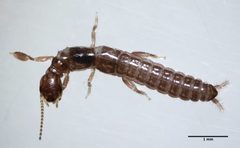
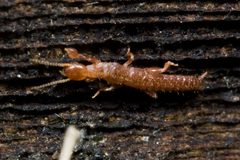
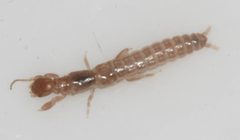
Soft-bodied insects with elongated, cylindrical bodies. Forelegs modified with silk-producing glands on the , containing dozens of tiny silk ejectors. Males possess wings with distinctive venation patterns useful for identification; females are wingless. Silk fibers produced are among the finest known in nature, measuring 35–40 nanometers in thickness.
Habitat
Constructs silk galleries in concealed microhabitats including bark crevices, leaf litter, and stone wall cracks. Haploembia tarsalis in California occupies dryland environments, grazing on stone walls and rocky substrates. Mediterranean occupy similar cryptic .
Distribution
Native to the Mediterranean region; introduced and naturalized in California (western United States), with records from the Santa Cruz Mountains and Tbilisi area of Georgia. H. tarsalis first reported in Italy from the Tuscan Archipelago. elsewhere.
Diet
Haploembia tarsalis grazes on lichens and dried mosses.
Behavior
Females construct extensive silk tunnel systems used as shelter and protection. Silk exhibits dynamic water-responsive properties: when dry, forms loose fibers; when wet, transforms into a cohesive, hydrophobic film that repels water. Haploembia tarsalis females exhibit antisocial, solitary consistent with parthenogenetic . H. solieri females display social behavior in colony formation. Females perform complex spinning routines involving over 10,000 steps. Males do not feed and do not participate in social dynamics or silk production.
Human Relevance
Introduced in California, where H. tarsalis has become naturalized. Silk properties of potential interest for bioinspired materials research, including biodegradable coatings, nano-fiber textiles, and moisture-responsive smart surfaces.
Similar Taxa
- AntipaluriaTropical webspinners that produce denser silk forming smooth film-like coverings on bark; distinguished from Haploembia by preference and silk .
- PararhagadochirTropical with silk that transforms from fibers to film when wet; differs from Haploembia in geographic distribution and silk structural properties.
- EmbiaRelated in ; distinguished by taxonomic placement and geographic distribution patterns in Mediterranean region.
More Details
Silk Properties
Haploembia tarsalis silk demonstrates high water resistance with contact angles nearly identical to water- controls. The silk's protein structure allows it to trap water between threads, solubilizing into a thin, slippery, hydrophobic film when wet—functioning as a protective 'raincoat' for the insects.
Reproductive Biology
The contains both parthenogenetic (H. tarsalis) and sexually reproducing (H. solieri) , with the parthenogenetic lineage showing higher genetic variation despite . A putative hybrid between these species has been identified.
Invasion Biology
H. tarsalis has successfully established in California, representing a well-documented case of Mediterranean-to-California introduction. The ' parthenogenetic likely facilitates establishment in new regions.
Sources and further reading
- BugGuide
- Wikipedia
- GBIF taxonomy match
- iNaturalist taxon
- NCBI Taxonomy
- Catalogue of Life
- Haploembia tarsalis silk - Entomology Today
- Why Webspinners Earn the Prize for Nature's Best Raincoat
- The first record of Haploembia solieri (Rambur, 1842) (Insecta, Embioptera) in Georgia
- Resolving two Haploembia (Embioptera: Oligotomidae) cryptic species: molecular data confirms parthenogenetic females can be distinguished by their antisocial behavior
- Unexpected complexity of the Embioptera (Insecta) fauna of the Tuscan Archipelago (Italy), with the disambiguation of two species of Haploembia Verhoeff, 1904 and description of a new species of Embia Latreille, 1825