
Haploembia solieri
(Rambur, 1842)
bicolored webspinner
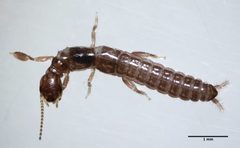
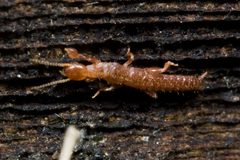
Haploembia solieri is a sexually reproducing webspinner in the Oligotomidae, distinguished from the parthenogenetic H. tarsalis by its social and smaller size. are orange and black, approximately 11 mm in length. The species produces nano- silk fibers using specialized silk ejectors on the front , which they use to construct tunnel systems under bark or in crevices. Originally described from Europe, it has been introduced to North America and recorded from Georgia in the Caucasus region.
Pronunciation
How to pronounce Haploembia solieri: /ˌhæploʊˈɛmbiə soʊliˈɛri/
These audio files are automatically generated. While they are not always 100% accurate, they are a good starting point.
Identification
Distinguished from the cryptic Haploembia tarsalis by social (H. solieri is social, H. tarsalis is antisocial), smaller size (ratio of 1.44 with H. tarsalis being larger), and confirmed by molecular data of the Histone III subunit. Coloration patterns are more variable and less reliable for identification than behavioral differences. H. solieri reproduces sexually, while H. tarsalis reproduces parthenogenetically.
Images
Appearance
are orange and black, approximately 11 mm in length. Like all webspinners, they possess enlarged front bearing dozens of tiny silk ejectors used to produce silk fibers.
Habitat
Found under bark and in crevices of stone walls, where individuals construct silk tunnel systems. Occupies both natural and human-modified environments including stone wall crevices in mountainous regions.
Distribution
Native to Europe and Northern Asia (excluding China). Introduced to North America, with established in California. First recorded from Georgia (Caucasus region) in 2023. GBIF records indicate presence in Crimea and Kriti (Crete).
Behavior
Exhibits social , with females forming colonies, caring for young, and performing elaborate silk-spinning routines involving over 10,000 steps. Constructs tunnel systems using silk produced from tarsal ejectors; silk forms protective shelters that transform from fibrous to film-like when wet, creating water- surfaces. Males do not feed and do not participate in colony social dynamics or silk production.
Human Relevance
Introduced in California represent a naturalized . Silk properties may have potential applications for bioinspired materials research, including biodegradable coatings and moisture-responsive smart surfaces.
Similar Taxa
- Haploembia tarsalisCryptic distinguished by antisocial , parthenogenetic , larger size, and Mediterranean origin naturalized in California; both overlap in California distribution
More Details
Genome characteristics
size is smaller than H. tarsalis by a ratio of 1.44. Higher genetic variation has been observed in the H. tarsalis lineage compared to H. solieri. A putative hybrid between the two has been identified.
Silk properties
Produces nano- silk fibers between 35-40 nanometers in thickness, among the finest known in nature. Silk exhibits dynamic water interaction: when dry, fibers are loose; when wet, proteins solubilize into a thin, hydrophobic, slippery film that sheds water. This provides protection against flooding in tunnel systems.
Sources and further reading
- BugGuide
- Wikipedia
- GBIF taxonomy match
- iNaturalist taxon
- NCBI Taxonomy
- Catalogue of Life
- Haploembia tarsalis silk - Entomology Today
- A flower visiting jewel beetle that is not an Acmaeodera | Beetles In The Bush
- Why Webspinners Earn the Prize for Nature's Best Raincoat
- The first record of Haploembia solieri (Rambur, 1842) (Insecta, Embioptera) in Georgia
- Resolving two Haploembia (Embioptera: Oligotomidae) cryptic species: molecular data confirms parthenogenetic females can be distinguished by their antisocial behavior