
Rhagio
Fabricius, 1775
snipe flies, downlooker flies, down-looker flies
Species Guides
12- Rhagio albicornis
- Rhagio dichromaticus
- Rhagio floridensis
- Rhagio gracilis
- Rhagio hirtus
- Rhagio lineola(Small Fleck-winged Snipefly)
- Rhagio mystaceus(Common Snipe Fly)
- Rhagio plumbeus(Lead-colored Snipe Fly)
- Rhagio punctipennis(lesser variegated snipe fly)
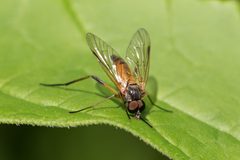
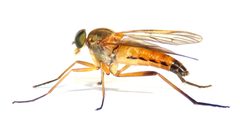
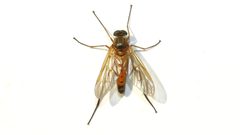
Rhagio is a worldwide of predatory snipe flies (Diptera: Rhagionidae) comprising approximately 170 . Several species are known as 'downlooker' or 'down-looker' flies due to their habit of perching on tree trunks in a -down position. The genus can be distinguished from other rhagionids by two key wing characters: an open anal and the absence of a kidney-shaped . Taxonomic revisions have been published for both eastern and western Nearctic species.
Pronunciation
How to pronounce Rhagio: /ˈræɡi.oʊ/
These audio files are automatically generated. While they are not always 100% accurate, they are a good starting point.
Identification
Distinguished from other rhagionid by the open anal on the wings and the lack of a kidney-shaped . -level identification requires examination of additional characters including coloration, thoracic patterning, and wing markings; keys are available for eastern and western Nearctic species.
Images
Habitat
Woodlands and forest edges; larvae occur in damp soil rich in decaying organic debris or in rotting wood.
Distribution
Worldwide distribution with approximately 170 . Eastern Nearctic records include Louisiana, Florida, Georgia, and Great Smoky Mountains National Park. Western Nearctic records include Montana, California, and Oregon. European species R. tringarius and R. lineola have been recorded in the Nearctic region.
Diet
Predatory. Larvae are predatory on other ; feeding habits are poorly documented.
Behavior
Several perch on tree trunks in a characteristic -down position, earning the 'downlooker flies'.
Ecological Role
Predatory snipe flies likely function as in soil and decaying wood during the larval stage.
Similar Taxa
- ChrysopilusAlso in Rhagionidae; distinguished by different wing venation and structure.
- XylophagusFormerly considered a of Rhagionidae; now placed in Xylophagidae; larvae are scavengers or in dead and decaying wood.
Sources and further reading
- BugGuide
- Wikipedia
- GBIF taxonomy match
- iNaturalist taxon
- NCBI Taxonomy
- Catalogue of Life
- Bug Eric: January 2014
- Bee Fly Parasitism of Tetracha virginica | Beetles In The Bush
- May | 2023 | Beetles In The Bush
- Missouri | Beetles In The Bush | Page 2
- The Rhagio dimidiatus Group in Western North America (Diptera, Rhagionidae)
- A Revision of the Eastern Nearctic Species of Rhagio Fabricius (Diptera: Rhagionidae)
- Structure of the mouthparts of the larvae of the flies Rhagio and Sargus in relation to feeding habits
- The eye and its relation to the cranial nervous system in the larva of the brachyceron Rhagio scolopaceus (L.) (Diptera: Rhagionidae)
- The genome sequence of a snipefly, Rhagio lineola Fabricius, 1794.