Rhagio plumbeus
Say, 1823
Lead-colored Snipe Fly
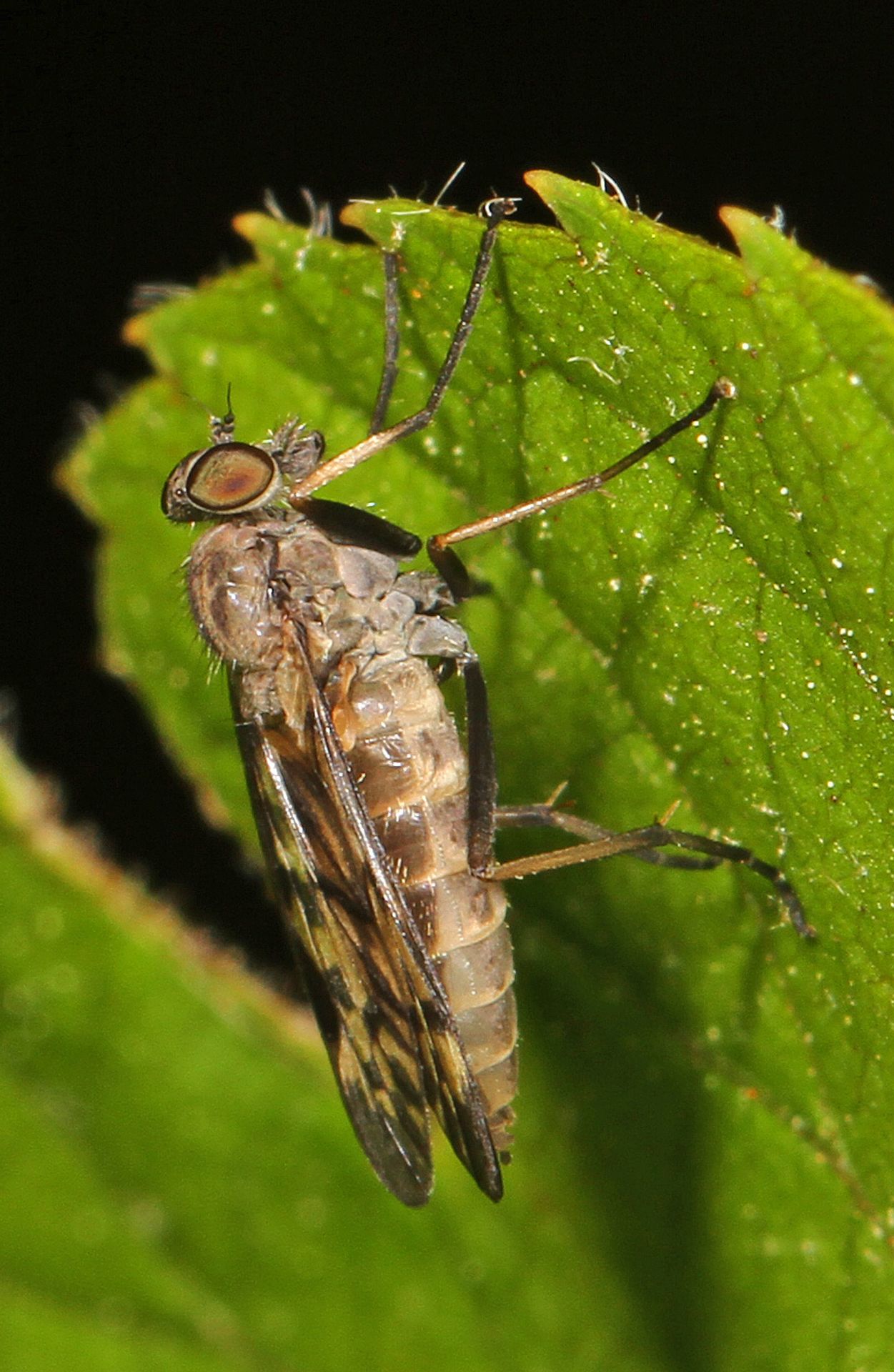
Rhagio plumbeus is a snipe fly in the Rhagionidae, characterized by its lead-gray coloration that gives the its name. are medium-sized flies found in moist woodland during late spring and early summer. Like other members of the Rhagio, this species exhibits in structure, with males having eyes and females having dichoptic eyes. The species is widely distributed across eastern and central North America.

Pronunciation
How to pronounce Rhagio plumbeus: //ˈræɡi.oʊ ˈplʌm.bi.əs//
These audio files are automatically generated. While they are not always 100% accurate, they are a good starting point.
Identification
Rhagio plumbeus can be distinguished from other Rhagio by its uniformly lead-gray (plumbeus) body coloration without the patterned markings seen in such as R. mystaceus. Males are identified by that meet at the top of the (), while females have eyes separated by a distinct gap (dichoptic). The species lacks the golden scaling of Chrysopilus ornatus, another rhagionid found in similar . Body length ranges approximately 8-12 mm.
Images
Habitat
Moist woodlands, forest edges, and riparian corridors with abundant understory vegetation. are frequently observed resting on foliage in shaded areas.
Distribution
Eastern and central North America, ranging from the northeastern United States west to the Great Plains and south to the Gulf Coast. Records extend from New England and southern Ontario through the Midwest to Texas and Florida.
Seasonality
active primarily in late spring through early summer, with peak activity in May and June. Some individuals may persist into July depending on latitude and local conditions.
Behavior
are typically found resting on leaves in the understory, often facing downward. They exhibit slow, deliberate movements and are reluctant fliers, usually taking only when directly disturbed. Males use their to detect females for mating.
Similar Taxa
- Chrysopilus ornatusAlso in Rhagionidae but distinguished by golden scaling on body, smaller size (~8-10 mm), and more slender build; found in similar moist woodland
- Rhagio mystaceusCongeneric snipe fly with distinct patterned markings on and rather than uniform lead-gray color; males also but with different body patterning