
Chrysopilus
Macquart, 1826
snipe flies
Species Guides
20- Chrysopilus andersoni
- Chrysopilus arctiventris
- Chrysopilus basilaris
- Chrysopilus connexus
- Chrysopilus davisi
- Chrysopilus fasciatus(banded snipe fly)
- Chrysopilus foedus(Striped Sand Grasshopper)
- Chrysopilus griffithi(Griffith's snipe fly)
- Chrysopilus longipalpus
Chrysopilus is a diverse of snipe flies in the Rhagionidae, comprising approximately 300 with worldwide distribution across all biogeographical regions. The genus includes both extant and fossil species, with some fossil members preserved in amber. Several species exhibit metallic scaling on the , giving a distinctive appearance. Larval development occurs in moist, decaying organic substrates including rotting wood and damp soil.
Pronunciation
How to pronounce Chrysopilus: /ˌkrɪsoʊˈpaɪləs/
These audio files are automatically generated. While they are not always 100% accurate, they are a good starting point.
Identification
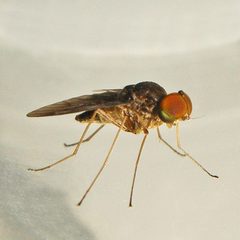
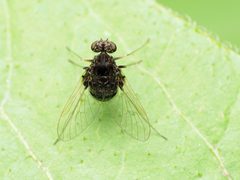
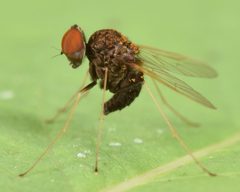
Distinguished from other Rhagionidae by combination of: metallic scaling in many (though not universal); wing venation characteristics; and genitalic structures requiring microscopic examination. Within the genus, species identification relies on subtle differences in coloration, leg structure, and male terminalia. Fresh specimens with intact metallic are most readily recognized; worn specimens may require dissection for definitive identification.
Images
Appearance
often possess delicate, metallic appressed to the , creating a sparkly appearance that becomes abraded with wear. Body length ranges from approximately 8–10 mm. in arrangement: males have eyes in contact at the top of the , while females have eyes set apart dorsally. Females typically have a more robust, pointed ; males are more slender.
Habitat
Moist woodlands, forest edges, and open hardwood . Larval habitats include damp soil rich in decaying organic debris, rotting wood, and tunnels of xylobiont insects in tree trunks. frequently encountered on foliage in understory vegetation.
Distribution
Worldwide distribution encompassing all biogeographical regions. Documented from North America (northeastern U.S., southern Canada, south to Florida, west to Manitoba and Kansas), Brazil (multiple new described from various regions), Russian Far East (Sakhalin, Yakutia, East Siberia), and Europe (Denmark, Norway, Sweden). Fossil species known from amber deposits.
Seasonality
activity primarily in late spring through mid-summer. In northeastern North America, peak activity occurs in June, with records from May through July.
Life Cycle
Larvae develop in moist, decaying organic substrates. Larvae of some are xylophilous, occurring in rotting wood, under bark, or in tunnels of xylobiont insects. Specific larval diet remains uncertain, though suspected to be predatory on other . feeding habits are poorly documented; conclusive evidence of adult diet is lacking in available literature.
Behavior
are often observed resting on foliage in shaded understory . Larvae of some exhibit xylophilous habits, developing in association with decaying wood or xylobiont insect tunnels.
Ecological Role
Larvae likely function as in decaying wood and soil microhabitats, though direct evidence is limited. Potential role in decomposition processes through association with decaying organic matter.
Human Relevance
No documented economic or medical importance. Occasionally encountered by naturalists and photographers due to attractive metallic appearance of fresh specimens. Subject of ongoing taxonomic research, with numerous new described in recent decades.
Similar Taxa
- Other Rhagionidae genera (e.g., Rhagio)Lack metallic scaling; differ in wing venation and genitalic structures
- Tabanidae (horse flies)Larger body size, different wing venation, biting mouthparts in females; Chrysopilus has slender build and non-biting mouthparts
- Therevidae (stiletto flies)Similar slender build but differ in leg structure and larval (Therevidae larvae are sand-dwelling )
More Details
Etymology
name derived from Greek 'chryso-' (gold) and Latin 'pilus' (hair), referring to the golden or metallic appearance of many .
Taxonomic activity
The has been subject to intensive recent taxonomic revision, with 11 new described from Brazil in 2007 and additional new species described from Russia and other regions, indicating substantial undescribed diversity remains.
Fossil record
Fossil members of the are sometimes found preserved in amber, providing evidence of long evolutionary history.
Sources and further reading
- BugGuide
- Wikipedia
- GBIF taxonomy match
- iNaturalist taxon
- NCBI Taxonomy
- Catalogue of Life
- Bug Eric: Ornate Snipe Fly
- Biology of xylophilous larvae of the rhagionid flies Chrysopilus dives and Chrysopilus nigrifacies (Diptera, Rhagionidae)
- Chrysopilus (Diptera: Rhagionidae) from Brazil: redescription of Chrysopilus fascipennis Bromley and description of eleven new species
- Description and molecular characterization of Chrysopilus kafkai sp. nov. (Diptera: Rhagionidae) from Serra da Bodoquena (Mato Grosso do Sul, Brazil)
- Diptera of Yakutia. Lower Brachycera: Athericidae, Xylophagidae and Rhagionidae (Diptera) with description of a new species of the genus Chrysopilus Macquart
- The genome sequence of the Little Snipefly, Chrysopilus asiliformis (Preyssler, 1791).