
Xylophagidae
Fallén, 1810
awl-flies, stink flies
Genus Guides
5- Arthropeas
- Coenomyia(stink fly)
- Dialysis
- Rachicerus
- Xylophagus(wood flies)
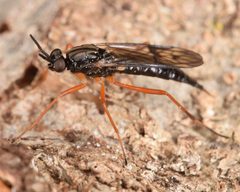
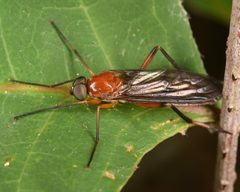
Xylophagidae is a small of lower brachyceran flies comprising nine extant and approximately 135 . Commonly known as awl-flies or stink flies, these insects are characterized by elongated bodies that resemble ichneumon wasps, with a constricted base of the and three-segmented . The family occurs across all biogeographical regions except the Afrotropics. Larvae are primarily associated with rotting wood, where many species are predatory on other insect larvae.

Pronunciation
How to pronounce Xylophagidae: //zaɪˌlɒfəˈdʒɪdiː//
These audio files are automatically generated. While they are not always 100% accurate, they are a good starting point.
Identification
Xylophagidae can be distinguished from similar-appearing ichneumon wasps (Hymenoptera) by their dipteran characteristics: single pair of functional wings with present, rather than two pairs of wings. Within Diptera, the combination of three-segmented , constricted abdominal base, and elongated body form separates them from other lower brachyceran . The family was historically considered a of Rhagionidae (snipe flies) but is now recognized as a distinct family within the infraorder Xylophagomorpha. are distinguished by antennal flagellomere number and abdominal coloration patterns.
Images
Habitat
are found in various terrestrial , often in wooded areas. Larvae are primarily associated with rotting wood, decaying wood, and environments. Some inhabit moist woodland settings and riparian corridors.
Distribution
The occurs in all biogeographical regions except the Afrotropics. Documented from North America, South America (Brazil, with new described from Santa Catarina, Amazonas, Maranhão, and São Paulo states), Europe, Asia (including Yakutia and East Siberia), and other regions. Species of Rachicerus, the most speciose with 70 species, are considered rare in collections and in the wild.
Diet
Larvae are often predatory, consuming other insect larvae living in rotting wood. feeding habits are not well documented; like related , adults may feed on nectar or not feed at all.
Life Cycle
Larvae develop in rotting wood. The larval stage of Exeretonevra angustifrons has been studied for exoskeletal calcium phosphate distribution, with deposits found in mouthparts and body wall likely serving a hardening function. Larvae of Xylophagus cinctus are freeze-tolerant, with specific physiological adaptations for cold environments. emerge from pupal within wood.
Behavior
are generally slow-moving and clumsy in . The 'stink fly' for Coenomyia ferruginea refers to a distinctive odor produced by these insects. of Rachicerus are notably rare in the wild and in scientific collections, making behavioral observations limited.
Ecological Role
Larvae function as of other wood-inhabiting insect larvae in decaying wood , contributing to nutrient cycling and within dead wood . Their presence indicates mature woodland with substantial dead wood .
Human Relevance
Minimal direct human relevance. Occasionally encountered by naturalists and entomologists in woodland . The rarity of Rachicerus in collections makes them of interest to dipteran systematists.
Similar Taxa
- Rhagionidae (snipe flies)Historically treated as within Rhagionidae; separated by three-segmented and constricted abdominal base in Xylophagidae
- Tabanidae (horse and deer flies)Sister group relationship; Xylophagidae lacks the large and biting mouthparts of tabanids
- AthericidaeRelated lower brachyceran ; often co-occurring in faunal surveys and requiring careful separation based on antennal and abdominal characters
More Details
Taxonomic history
Formerly treated as a of Rhagionidae; elevated to status and placed in the infraorder Xylophagomorpha. Subfamilies Coenomyiinae and Rachicerinae were sometimes treated as separate families (Coenomyiidae and Rachiceridae). The family name Xylophagidae derives from Greek 'xylon' (wood) and 'phagein' (to eat), referring to the wood-associated larvae.
Research challenges
of Rachicerus and other are considered rare in both field collections and museum specimens, making studies of individual variation, , and morphological characterization difficult. This rarity has limited comprehensive biological and ecological research on the .
Physiological adaptations
Larvae of Xylophagus cinctus exhibit freeze- with specific ion distribution mechanisms across during freezing. Larval show calcium phosphate deposition, particularly in mouthparts and body wall, likely as structural reinforcement for wood-boring habits.
Sources and further reading
- BugGuide
- Wikipedia
- NCBI Taxonomy
- Catalogue of Life
- Ted C. MacRae | Beetles In The Bush | Page 5
- Missouri | Beetles In The Bush | Page 2
- Insecta | Beetles In The Bush | Page 4
- Three new species of the genus Rachicerus Walker (Diptera, Xylophagidae) from Brazil
- Distribution of calcium phosphate in the exoskeleton of larval Exeretonevra angustifrons Hardy (Diptera: Xylophagidae)
- Diptera of Yakutia. Lower Brachycera: Athericidae, Xylophagidae and Rhagionidae (Diptera) with description of a new species of the genus Chrysopilus Macquart
- Effect of freezing on the transmembrane distribution of ions in freeze-tolerant larvae of the wood fly Xylophagus cinctus (Diptera, Xylophagidae)