
Melangyna arctica
(Zetterstedt, 1838)
Alder Halfband
Pronunciation
How to pronounce Melangyna arctica: //məˈlændʒɪnə ɑːrkˈtɪkə//
These audio files are automatically generated. While they are not always 100% accurate, they are a good starting point.
Identification
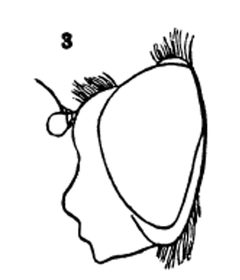
Distinguished from similar Melangyna by the combination of: wing entirely covered with microtrichia (not bare in basal areas); scutellar hairs short, not projecting beyond scutellum margin; and the specific pattern of pale markings on tergites 3–4. Male genitalia require examination for definitive identification.
Images
Appearance
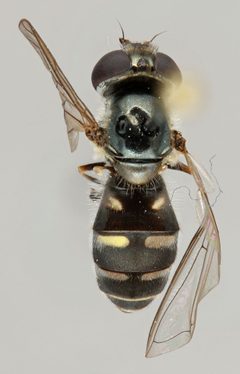
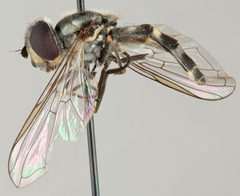
Wing length 5.75–7.5 mm. Tergites 3 and 4 bear white to yellow markings. Wing entirely covered with microtrichia. Scutellar hairs no longer than the scutellum itself. Male terminalia illustrated by Hippa (1968); larva depicted in colour by Rotheray (1994).
Habitat
Coniferous forests dominated by Abies, Picea, and Pinus; deciduous woodlands including Alnus, Betula, and Salix. Arboreal in habit, descending to lower vegetation to visit flowers.
Distribution
Palearctic: Fennoscandia, Britain and Ireland, Germany (Schwarzwald), Czech Republic, France (Pyrenees and Alps), Switzerland, Liechtenstein; North and Central Siberia to Kamchatka. Nearctic: Alaska and Canada, Rocky Mountains south to Colorado.
Seasonality
active April to June; period extends later at higher elevations.
Diet
Larvae are on trees; feed on nectar and pollen of Acer pseudoplatanus, Galium, Ilex, Prunus spinosa, Ranunculus, Salix, Stellaria, and Taraxacum.
Host Associations
- Acer pseudoplatanus - nectar source
- Galium - nectar source
- Ilex - nectar source
- Prunus spinosa - nectar source
- Ranunculus - nectar source
- Salix - nectar source
- Stellaria - nectar source
- Taraxacum - nectar source
Life Cycle
Larval stage associated with -infested trees. Complete with , larva, pupa, and stages; specific duration of developmental stages not documented.
Behavior
Arboreal habit; descend from to visit ground-level flowers. Strongly associated with woodland .
Ecological Role
Larvae function as agents of arboreal aphids. contribute to pollination of early spring woodland flowers.
Human Relevance
Potential value in natural suppression of pests in forestry; no documented negative impacts.
Similar Taxa
- Other Melangyna speciesRequire examination of male genitalia and wing microtrichia pattern for separation; M. arctica distinguished by complete wing microtrichia coverage and short scutellar hairs