
Melangyna
Verrall, 1901
Halfbands
Species Guides
6- Melangyna arctica(Alder Halfband)
- Melangyna coei(Coe's Halfband)
- Melangyna fisherii(Large-spotted Halfband)
- Melangyna labiatarum
- Melangyna lasiophthalma(Hairy-eyed Halfband)
- Melangyna umbellatarum(Bare-winged Halfband)
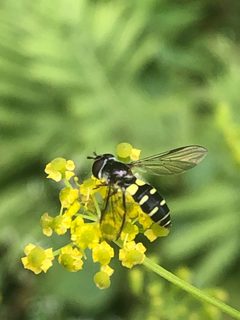
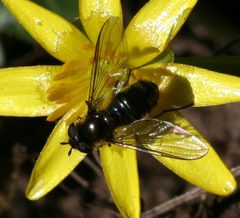
Melangyna is a of hoverflies (Syrphidae) distributed across the Holarctic region, with subgenera in the Nearctic, Palearctic, and Australasian regions. are frequent flower visitors, while larvae are predatory on aphids. The genus exhibits in and , with males typically larger than females and showing distinct foraging and exploration patterns.
Pronunciation
How to pronounce Melangyna: //mɛˈlændʒɪnə//
These audio files are automatically generated. While they are not always 100% accurate, they are a good starting point.
Images
Habitat
Coniferous woodlands; urban and semi-urban environments with flowering vegetation.
Distribution
Holarctic region: Northern and Western Europe (Denmark, Norway, Sweden), North America (Vermont, USA; British Columbia, Canada), Northern England and Scotland; Australasian region (Australia, New Zealand) for subgenus Austrosyrphus.
Seasonality
active from May onwards, with peak abundance between mid-June and mid-August.
Diet
feed on nectar and pollen; frequent visitors to umbellifer flowers including Heracleum and Angelica. Larvae are oligophagous of aphids.
Behavior
Males form small swarming . Sex-dependent differences in exploration and foraging: males and females exhibit distinct patterns in movement and resource acquisition, leading to differential use of floral resources.
Ecological Role
Larvae function as in . contribute to pollination as flower visitors, with sex-specific floral resource use patterns that may affect plant reproductive outcomes.
Human Relevance
Potential biocontrol agents for pest management. Flower visitation supports pollination services in natural and urban .
Sources and further reading
- BugGuide
- Wikipedia
- GBIF taxonomy match
- iNaturalist taxon
- NCBI Taxonomy
- Catalogue of Life
- A REVIEW OF THE NEARCTIC SPECIES OF MELANGYNA (MELIGRAMMA) FREY (DIPTERA: SYRPHIDAE)
- Habitat Exploration and Foraging in a Dominant Hover Fly ( Melangyna ) is Sex‐Dependent
- The genome sequence of a hoverfly , Melangyna compositarum (Verrall, 1873) (Diptera: Syrphidae).
- Seasonal variation in floral resource use by a hover fly (Melangyna) (Diptera: Syrphidae) and the western honey bee (Apis mellifera) (Hymenoptera: Apidae) in an urban setting.