
Melangyna lasiophthalma
(Zetterstedt, 1843)
Hairy-eyed Halfband
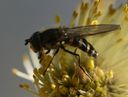
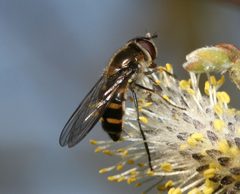
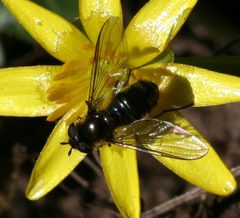
Melangyna lasiophthalma is a Holarctic hoverfly with a broad distribution across northern temperate regions. are active in spring, visiting diverse flowering plants in wooded and semi-open . The species is associated with deciduous and coniferous forests, riparian woodlands, and anthropogenic environments including gardens and orchards.
Pronunciation
How to pronounce Melangyna lasiophthalma: //mɛˈlæŋɡɪnə læˌsiːɔfˈθælmə//
These audio files are automatically generated. While they are not always 100% accurate, they are a good starting point.
Identification
The projecting facial prominence that extends beyond the frontal prominence is a key diagnostic feature. The wide post-orbital strip and yellow scutellar hairs help distinguish this from similar Melangyna. Male terminalia require examination for definitive identification; reference Hippa (1968) for figures. Larval identification follows Goeldlin (1974) and Rotheray (1994).
Images
Habitat
Quercus (oak) forest, Fraxinus and Salix gallery woods along rivers, Alnus (alder), Salix (willow), and Betula (birch) forests, Abies and Picea (coniferous) forest, Atlantic scrub, hedgerows, suburban gardens, parks, and orchards.
Distribution
Holarctic. Palearctic: Iceland and Fennoscandia south to Pyrenees and mountains of Spain; Ireland east through northern Europe and mountainous parts of Central Europe; east into European Russia and Siberia. Nearctic: Alaska south to Colorado and Maryland. Present in Belgium (Flanders, Brussels-Capital Region, Walloon Region).
Seasonality
fly March to June; period extends later at higher altitudes and more northerly latitudes.
Life Cycle
Larva described and figured by Goeldlin (1974) and in color by Rotheray (1994). Specific details and relationships are not documented in available sources.
Behavior
visit flowers for nectar and pollen. Flower records include Acer pseudoplatanus, Alnus glutinosa, Anemone nemorosa, Anthriscus, Caltha, Chrysosplenium oppositifolium, Corylus avellana, Euphorbia, Ilex, Lonicera xylosteum, Narcissus, Oxalis, Prunus laurocerasus, Prunus spinosa, Ranunculus, Salix, Sambucus, Sorbus aucuparia, Taraxacum, Tussilago, and Ulex.
Ecological Role
Human Relevance
Recorded from suburban gardens, parks, and orchards, indicating of anthropogenic . No documented economic or medical significance.
Similar Taxa
- Other Melangyna speciesRequire examination of facial prominence projection, post-orbital strip width, and scutellar hair coloration for separation
More Details
Taxonomic authority
Originally described by Zetterstedt in 1843.
Larval description sources
Goeldlin (1974) provided description and figures; Rotheray (1994) provided color figures of larva.
Male genitalia
Figured by Hippa (1968); important for definitive identification.