
Eupeodes montivagus
(Snow, 1895)
Red-tailed Aphideater
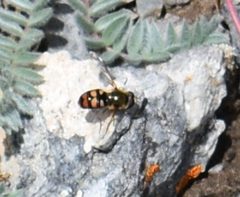
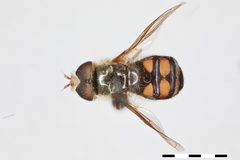
A flower fly (Syrphidae) known as the Red-tailed Aphideater. are that visit flowers for nectar. Larvae are , with females laying in or near aphid colonies. The was first described from Colorado by William Morton Wheeler in 1895.
Pronunciation
How to pronounce Eupeodes montivagus: /juːˈpiːoʊdiːz mɒnˈtɪvəɡəs/
These audio files are automatically generated. While they are not always 100% accurate, they are a good starting point.
Identification
resemble or bees with enormous that nearly meet at the top of the in females. Distinguished from bees and wasps by having only one pair of wings (Diptera), very short , and an extendable with a sponge-like pad rather than chewing . Hovering is characteristic. Larvae are cryptic, often mistaken for caterpillars or debris on leaves.
Images
Habitat
Gardens and areas with flowering plants where colonies occur. Associated with pine trees and rosebushes based on larval observation records.
Distribution
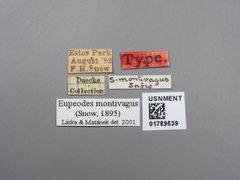
Described from the foothills near Colorado Springs, Colorado. GBIF records indicate presence in North America.
Seasonality
most conspicuous in spring and fall when peak.
Diet
Larvae are obligate . feed on nectar and are .
Life Cycle
Females lay in or near colonies. Larvae pass through three instars before pupating. Pupae are convex, pear-shaped, and attached to leaves or stems. emerge from the pupal case.
Behavior
exhibit hovering . Larvae are cryptic, disguised as discolored leaf patches or debris.
Ecological Role
Larval stage provides of . contribute to pollination of various flowers.
Human Relevance
Beneficial insect in gardens and agriculture. Larvae reduce without chemical intervention. Often killed inadvertently by gardeners mistaking larvae for pests.
Similar Taxa
- Syrphus spp.Similar appearance; both are with -mimicking coloration
- Allograpta spp.Shares syrphine characteristics and -feeding larval
- Toxomerus spp.Similar small size and flower-visiting , though generally smaller
Misconceptions
Larvae are frequently mistaken for foliage-munching caterpillars or garden pests and killed unnecessarily. are often mistaken for bees or due to mimicry.