
Mixogaster fattigi
Skevington & Locke, 2019
Fattig's Ant Fly
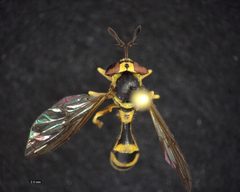
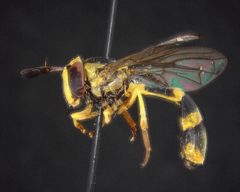
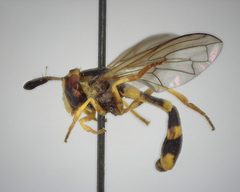
Mixogaster fattigi is a of -mimicking hoverfly ( Syrphidae, Microdontinae) described in 2019. The Mixogaster belongs to the tribe Microdontini, a group whose larvae are known to develop within ant colonies as or of ant . The specific epithet honors entomologist Delbert La Rue Fattig. The species is part of a lineage exhibiting remarkable morphological convergence with ants, representing an evolutionary strategy to avoid while foraging or accessing ant-associated resources.
Pronunciation
How to pronounce Mixogaster fattigi: /ˌmɪksəˈɡæstər ˈfætɪɡi/
These audio files are automatically generated. While they are not always 100% accurate, they are a good starting point.
Identification
As a member of the Mixogaster, M. fattigi likely exhibits the characteristic -mimicking features of the group: a constricted waist (petiole-like narrowing between and ), elbowed , and coloration patterns resembling small ants. The genus is distinguished from other Microdontini by specific wing venation patterns and details of the capsule structure. Definitive identification requires examination of male terminalia and comparison with the original description. The name was established by Skevington and Locke in 2019.
Images
Behavior
-mimicking has been observed in related Mixogaster , involving slow, deliberate movement patterns that resemble ant locomotion rather than typical dipteran . This behavioral mimicry complements morphological adaptations.
Ecological Role
As a member of Microdontinae, the likely functions as an or within colonies during its larval stage. hoverflies in this do not feed at flowers like typical syrphids but instead forage in association with ants, possibly obtaining honeydew or other ant-derived resources.
Human Relevance
The name honors Delbert La Rue Fattig, a notable entomologist associated with the Crooked Beak Workshop and contributor to insect . The 2019 description represents ongoing documentation of North American hoverfly diversity.
Similar Taxa
- Mixogaster politaCongeneric with similar -mimicking ; distinguished by specific structural features of the and male genitalia.
- Other Microdontini genera (e.g., Microdon, Paragodon)Share characteristics including reduced mouthparts and -associated larvae, but differ in wing venation, structure, and details of the petiole-like waist constriction.