
Copestylum
Macquart, 1846
Bromeliad Flies
Species Guides
27- Copestylum anna(Anna's bromeliad fly)
- Copestylum apiciferum
- Copestylum avidum(yellow-spotted bromeliad fly)
- Copestylum barei(Violet Bromeliad Fly)
- Copestylum caudatum(hairy-horned bromeliad fly)
- Copestylum comstocki(Comstock's Bromeliad Fly)
- Copestylum florida(Florida bromeliad fly)
- Copestylum fornax
- Copestylum fraudulentum
Copestylum is one of the largest of hoverflies (Syrphidae) in the Americas, comprising more than 300 . The genus is neotropical in origin, with only four species recorded outside the Americas, likely introduced through cactus trade. Larvae are saprophagous and develop in decaying tissues of columnar cacti and other succulent plants, playing important roles in nutrient recycling in xeric environments. are commonly known as bromeliad flies.
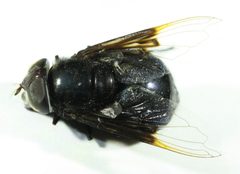
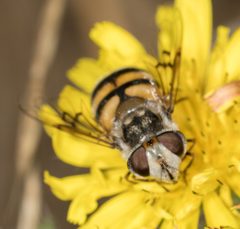
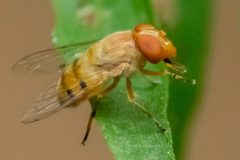
Pronunciation
How to pronounce Copestylum: //koʊˈpɛstɪləm//
These audio files are automatically generated. While they are not always 100% accurate, they are a good starting point.
Images
Habitat
Larvae inhabit decaying tissues of columnar cacti (Cactaceae), particularly necrotic arms and stems, as well as Agavaceae tissues. Found in xeric environments including semiarid scrublands, with breeding substrates including necrotic pockets and rots in cactus stems. associated with flowering plants in these .
Distribution
Primarily neotropical; to the Americas with highest diversity in Mexico and Central America. Recorded from Barranca de Metztitlán Reserve in Hidalgo, México, and Veracruz state. Four introduced outside Americas, probably via cactus importation.
Seasonality
and abundance higher during rainy season; composition shifts seasonally with temporal partitioning among . Larvae collected in March in central Mexico.
Diet
Saprophagous; larvae feed on decayed cactus tissues. Feeding strategies vary by : some species scoop firmer decayed tissues, while others feed on semiliquid or watery decayed tissues. One species recorded from fallen fruits of Casearia combaymensis (Salicaceae) in Brazilian Amazon.
Host Associations
- Isolatocereus dumortieri - breeding substrate and food sourceColumnar cactus in central Mexico
- Opuntia - larval Decaying platyclades in Veracruz, Mexico
- Casearia combaymensis - larval food substrateFallen fruits; first record for Salicaceae
- Agavaceae - larval Decaying tissues
Life Cycle
Larvae develop in decaying cactus tissues, with distinct morphological adaptations for feeding strategy. occurs within the breeding substrate. Preliminary data exist for some ; detailed developmental stages described for C. tamaulipanum and C. lentum including larval and puparial .
Behavior
Larvae exhibit two distinct feeding morphologies: scooping possess specialized grinding mills in skeletons, armored for gripping during tunneling, and short breathing tubes; straining/intermediate species have reduced armature and elongated posterior breathing tubes to obtain atmospheric oxygen from decomposed substrates. presumably oviposit in decayed cactus tissues where provides feeding and breeding substrates.
Ecological Role
Ecologically important in nutrient recycling processes in xeric environments; larvae assist in degradation of cactus necroses and contribute to decomposition of columnar cacti. Part of cactus-microorganism-hoverfly system involving bacteria, yeasts, and cactophilic . Gut bacterial differ between species, dominated by Enterobacteriaceae in some species with putative nitrogen-fixing and pectinolytic .
Human Relevance
Some introduced outside native range, probably through cactus horticulture trade. Potential importance in understanding cactus decomposition and nutrient cycling in arid .
Similar Taxa
- VolucellaBoth in tribe Volucellini; Volucella larvae also saprophagous but typically in and nests rather than cactus tissues
- EristalisBoth in Eristalinae with rat-tailed larvae, but Eristalis typically in aquatic or semi-aquatic organic matter rather than cactus necroses
More Details
Gut microbiota
Bacterial in larval guts differ between and are more similar between larval species than between larvae and their breeding substrate, suggesting gut depend on , evolutionary history, and innate rather than diet alone.
Temporal dynamics
Copestylum exhibit significant seasonal variation in composition, with high overlap during dry season and low overlap during rainy season, indicating temporal resource partitioning among .
Taxonomic diversity
contains 12 recognized subgenera including Copestylum, Phalacromyia, Glaurotricha, Atemnocera, Apophysophora, Megametopon, Camerania, Viereckomyia, Lepidopsis, Volosyrpha, Volucellosia, and Tachinosyrphus.
Sources and further reading
- BugGuide
- Wikipedia
- GBIF taxonomy match
- iNaturalist taxon
- NCBI Taxonomy
- Catalogue of Life
- Eumastacidae | Beetles In The Bush
- Immature stages, morphology and feeding behaviour of the saprophytic syrphids Copestylum tamaulipanum and Copestylum lentum (Diptera: Syrphidae)
- Bacteria Associated with Copestylum (Diptera, Syrphidae) Larvae and Their Cactus Host Isolatocereus dumortieri
- Temporal shifts and niche overlapping in Copestylum (Diptera, Syrphidae) communities reared in cactus species in a central Mexican scrubland
- Life Cycle, Adult and Immature Stages of a New Species of <I>Copestylum</I> (Diptera: Syrphidae) from Mexico Reared from Cactaceae
- Description of the female of Copestylum tigrinum Ricarte & Hancock in Ricarte et al., 2015 (Diptera, Syrphidae), first record in mainland South America and new larval host plant