
Volucella
Geoffroy, 1762
hover-flies, flower flies
Species Guides
3- Volucella arctica(Arctic Swiftwing)
- Volucella evecta(Eastern Swiftwing)
- Volucella facialis(Yellow-faced Swiftwing)
Volucella is a of large, broad-bodied hoverflies in the Syrphidae. These flies are notable for their of stinging Hymenoptera—particularly bumble bees and —which provides protection from . are regular flower visitors that feed on nectar, while larvae develop as in the nests of social bees and , functioning as and predators of larvae. The genus exhibits strong migratory and males are often territorial.
Pronunciation
How to pronounce Volucella: //vɔˈluː.sɛl.lə//
These audio files are automatically generated. While they are not always 100% accurate, they are a good starting point.
Identification
Distinguished from bees by single pair of wings (versus two pairs in Hymenoptera) and short, (versus longer, elbowed antennae in bees). The extended, downward-projecting and plumose are diagnostic for the . Volucella zonaria can be separated from V. inanis by chestnut-colored second tergite and broad black abdominal markings. In North America, Volucella bombylans complex is the only recognized , though evidence suggests this represents a cryptic .
Images
Appearance
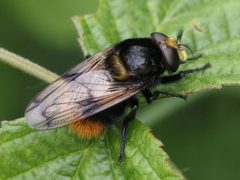
Large, broad-bodied flies with robust builds. Distinctive (feathery) on the . extended downward, creating a pronounced facial projection. Many exhibit striking yellow and black abdominal banding that mimics the coloration of bumble bees or . possess a single pair of wings (characteristic of Diptera) with the hindwings reduced to small knob-like .
Habitat
frequent flowering plants in gardens, meadows, and woodland edges. Urban and suburban areas are commonly occupied, particularly by migratory . Larval is restricted to the nests of social bees and , where they inhabit detritus accumulations at nest bases.
Distribution
Widespread across the Palaearctic region. Volucella zonaria colonized the United Kingdom in the late 1930s (initially in London), spreading to become frequent across England and Wales and reaching central Scotland. North American records represent Volucella bombylans complex, primarily distributed in western regions. Multiple documented from the Pothwar region of Punjab, Pakistan.
Seasonality
active from May through November in temperate regions, with peak abundance typically in August. Presence strongly correlated with abundance of in previous year.
Diet
feed on nectar from flowers; Volucella zonaria shows particular preference for Buddleja ( bush). Larvae scavenge debris and consume larvae within and nests.
Host Associations
- Bombus - larvae inhabit nests
- Vespula vulgaris - larvae inhabit common nests
- Vespula germanica - larvae inhabit German wasp nests
Life Cycle
Larvae develop within active nests of social bees and , where they function as and on larvae. occurs within the host nest. emerge and disperse to feed on floral nectar. Specific details of deposition and complete developmental duration are not well documented.
Behavior
Strongly migratory, with capable of long-distance . Males frequently exhibit territorial , defending favorable perching sites or floral resources. often observed sunning on leaves. of stinging Hymenoptera reduces risk. Volucella zonaria shows correlation between population levels and preceding summer abundance.
Ecological Role
contribute to pollination through regular flower visitation. Larvae function as nest associates () of social Hymenoptera, with mixed - that may influence nest dynamics. The represents a classic example of in insect .
Human Relevance
Beneficial as in gardens and agricultural settings. Larval association with nests occasionally brings them to human attention, though they do not attack healthy colonies. Some , particularly V. zonaria, have expanded range in response to urbanization and anthropogenic activity.
Similar Taxa
- CopestylumFormerly included some now placed in Copestylum (e.g., C. mexicanum, the Mexican cactus fly); distinguished by larval in rotting cactus tissue rather than social insect nests
- BombusBumble bees are the primary mimicry models; distinguished by two pairs of wings, longer elbowed , and ability to sting
- Vespa crabroEuropean hornet is the mimicry model for V. zonaria; distinguished by larger size, two pairs of wings, and potent sting
More Details
Mimicry and visual specializations
Volucella pellucens males possess a specialized frontal- retinal region termed the 'love spot,' containing photoreceptors with superior temporal resolution adapted for mate recognition and pursuit during high-speed chasing . This represents a morphological and physiological for binocular vision in mate location.
Taxonomic complexity
North American assigned to Volucella bombylans likely represent a cryptic based on evidence, though currently treated as a single valid . The has undergone taxonomic revision with some former members (e.g., Mexican cactus fly) reassigned to Copestylum.
Sources and further reading
- BugGuide
- Wikipedia
- iNaturalist taxon
- NCBI Taxonomy
- Catalogue of Life
- This Hover Fly Engages in Identity Theft | Bug Squad
- Bug Squad
- Hide the Cactus! | Bug Squad
- A bee or not a bee? That is the question! Syrphid fly, Volucella bombylans — Bug of the Week
- Meet six unsung heroes of the pollination world - Buglife Blog - Buglife
- Archive — Bug of the Week
- Morphological and electrophysiological specializations of photoreceptors in the love spot of hover fly Volucella pellucens
- New records of hoverflies of the genus Volucella Geoffroy (Diptera: Syrphidae) from Pakistan along with a checklist of known species
- The genome sequence of Hornet Plumehorn hoverfly, Volucella zonaria (Poda, 1761).