
Copestylum florida
(Hull, 1941)
Florida bromeliad fly
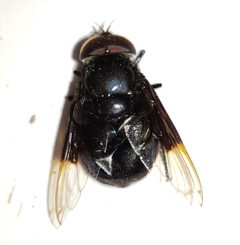
Copestylum florida is a syrphid fly commonly known as the Florida bromeliad fly. It belongs to the Copestylum, a group of flies associated with bromeliad plants. The species has been documented in Florida and the Carolinas.
Pronunciation
How to pronounce Copestylum florida: /koˈpɛ.stɪ.ləm ˈflɔ.rɪ.də/
These audio files are automatically generated. While they are not always 100% accurate, they are a good starting point.
Identification
The Florida bromeliad fly can be distinguished from other Copestylum by its association with bromeliad microhabitats. Members of the Copestylum typically exhibit robust body forms with coloration patterns that may include metallic or banded . Specific diagnostic features for C. florida require examination of morphological characters described in the original description by Hull (1941).
Images
Habitat
Bromeliad plants, particularly in the water-filled leaf axils (tanks) that characterize these epiphytic and terrestrial plants.
Distribution
Florida, North Carolina, and South Carolina.
Host Associations
- Bromeliaceae - Associated with bromeliad plants, likely utilizing the water-filled leaf axils for larval development
Ecological Role
Member of the bromeliad-associated insect ; likely contributes to nutrient cycling within bromeliad tank .
Similar Taxa
- Other Copestylum speciesShared characteristics including robust body form and bromeliad association; specific identification requires detailed morphological examination
- Other syrphid flies in EristalinaeGeneral similarity in body plan; Copestylum distinguished by bromeliad specialization and specific wing venation patterns
More Details
Taxonomic note
Originally described by Hull in 1941. The specific epithet 'florida' refers to the state of Florida, where the was first documented.
Bromeliad association
The 'Florida bromeliad fly' reflects the documented association with bromeliad plants. Many Copestylum are known to have larvae that develop in the water accumulated in bromeliad leaf axils, though this specific detail has not been explicitly confirmed for C. florida in the available sources.
Sources and further reading
- BugGuide
- Wikipedia
- GBIF taxonomy match
- iNaturalist taxon
- CDFA to Host Fruit Fly Workshop, Free to Participants | Bug Squad
- Bugs in Orange and Black, Part II: A spooky southern predator heads north in a warming world – Florida predatory stink bug, Euthyrhynchus floridanus — Bug of the Week
- Another Invasive Mosquito Species Arrives in Florida
- The (almost) Florida-endemic Cicindelidia scabrosa | Beetles In The Bush
- Another Non-Native Mosquito Species Adds to Growing List in Florida
- Hemp Pests Documented in New Guide for Florida Growers