
Chalcosyrphus libo
(Walker, 1849)
Long-haired Leafwalker
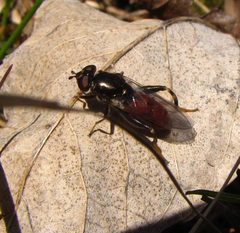
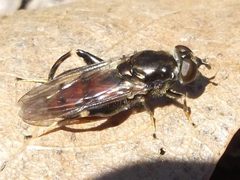
Chalcosyrphus libo is an uncommon of syrphid fly known by the Long-haired Leafwalker. It is characterized by an all-black body without the steel blue highlights seen in related species or the red abdominal markings present in . The species exhibits notably enlarged and ventrally spinose metafemora with correspondingly curved tibiae, features whose function remains unclear but may relate to substrate interaction on woody surfaces. are associated with dead and decaying wood, where females oviposit and larvae develop as saprophages. The species has been observed in north-central North America.
Pronunciation
How to pronounce Chalcosyrphus libo: /ˌkælkoʊˈsɜrfəs ˈlaɪboʊ/
These audio files are automatically generated. While they are not always 100% accurate, they are a good starting point.
Identification
Chalcosyrphus libo can be distinguished from by its uniformly black coloration lacking steel blue highlights (present in C. chalybeus) and absence of red abdominal markings (present in C. piger). The possesses distinctly enlarged metafemora with spines and curved tibiae, features visible in lateral view. Males exhibit (contiguous) . The overall body form is relatively large and robust compared to many flower flies, with a hulking appearance suggestive of dead wood association.
Images
Habitat
Associated with dead and decaying wood, particularly recently fallen or wind-thrown hardwood trees. have been observed repeatedly returning to and landing on dead tree trunks. The requires woody substrates for larval development.
Distribution
North-central North America, including Canada and the United States. Specific records include Vermont. The is described as uncommon throughout its range.
Diet
feed on pollen. Larvae are saprophages, developing in decaying wood and possibly feeding on fermenting sap.
Life Cycle
Females oviposit on or near dead wood. Larvae develop within decaying wood as saprophages rather than . likely occurs within the wood substrate. emerge and are active during warmer months.
Behavior
exhibit strong fidelity to dead wood substrates, repeatedly returning to dead tree trunks when disturbed. The enlarged hind legs may facilitate movement on bark or woody surfaces, though this function remains unconfirmed. Males possess contiguous . The does not typically visit flowers for nectar, instead obtaining pollen from leaf surfaces.
Ecological Role
Larvae contribute to wood decomposition as saprophages in dead and decaying hardwood. may serve as through pollen consumption, though their flower-visiting appears limited compared to other syrphids.
Similar Taxa
- Chalcosyrphus chalybeusSimilar all-black coloration but distinguished by steel blue highlights not present in C. libo
- Chalcosyrphus pigerSimilar body form and black coloration but possesses red abdominal markings absent in C. libo
- Xylota spp.Related with similar dead wood association and saprophagous larvae; distinguished by subtle differences in body proportions and leg
Sources and further reading
- BugGuide
- Wikipedia
- GBIF taxonomy match
- iNaturalist taxon
- NCBI Taxonomy
- Bug Eric: Eight Illinois Wasp and Bee Mimics in Twenty Minutes
- Bug Eric: Beetle Bonanza
- Diptera | Beetles In The Bush | Page 5
- June | 2012 | Beetles In The Bush
- Bicycle ride around Lake Tahoe | Beetles In The Bush
- Archives | Beetles In The Bush