
Brachypalpus
Macquart, 1834
Catkin Flies
Species Guides
7- Brachypalpus alopex(Bumblebee Catkin Fly)
- Brachypalpus cyanella(Longnose Catkin)
- Brachypalpus cyanogaster(Bluebottle Catkin Fly)
- Brachypalpus femorata(Orange Catkin Fly)
- Brachypalpus oarus(eastern catkin)
- Brachypalpus
- Brachypalpus undescribed-b
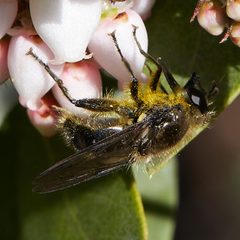
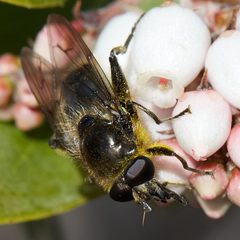
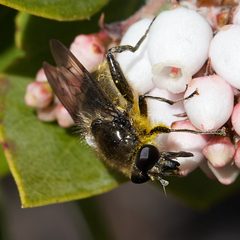
Brachypalpus is a of hoverflies (Syrphidae) commonly known as catkin flies. are distinguished by their triangular that projects forward and downward, and males possess a spur on the hind . The genus comprises approximately 15 described distributed primarily across the Holarctic region. Larvae develop in decaying wood and sap flows under tree bark.
Pronunciation
How to pronounce Brachypalpus: /bɹəˈkaɪpəlpəs/
These audio files are automatically generated. While they are not always 100% accurate, they are a good starting point.
Identification
Images
Appearance
have a triangular that is produced well forward and somewhat downward. The and bear often rather long pile. Hind is swollen and bears an obtuse spur apically on the surface. Males have a spur on the hind .
Habitat
Associated with woodland and forested areas where decaying wood and tree wounds provide larval development sites. are often found near flowering vegetation.
Distribution
Primarily Holarctic distribution, with recorded from Europe, Asia, and North America. Individual species show more restricted ranges within this broad region.
Seasonality
activity period varies by and latitude; generally active during spring and summer months in temperate regions.
Life Cycle
Larvae are of the rat-tailed type and develop in decaying sap under tree bark, within decaying trees and logs. Specific pupal has been described by Malloch, indicating complete with distinct larval and pupal stages.
Ecological Role
Larvae contribute to decomposition processes in forest by consuming decaying sap and associated microorganisms. likely serve as of flowering plants, though specific plant associations are not well documented.
Human Relevance
Occasionally encountered by entomologists and naturalists in woodland settings. No significant economic or medical importance documented.
Similar Taxa
- EristalisSimilar overall hoverfly , but Eristalis has a different shape and lacks the male hind spur characteristic of Brachypalpus.
- HelophilusShares tribe Milesiini and general body plan, but Helophilus typically have striped and lack the forward-projecting triangular of Brachypalpus.
More Details
Larval morphology
Larvae possess the characteristic 'rat-tailed' breathing siphon typical of many saprophagous syrphid larvae, allowing respiration while feeding in liquid or semi-liquid decaying matter.
Taxonomic history
Authored by Macquart in 1834; the has undergone various revisions with described by multiple authors including Meigen, Fallén, and Osten Sacken spanning the 19th and early 20th centuries.