
Merodon equestris
(Fabricius, 1794)
Narcissus bulb fly, greater bulb fly, large bulb fly, large Narcissus fly
Merodon equestris is a Holarctic hoverfly (Syrphidae) and a significant horticultural pest of bulbous plants. are bumblebee mimics with variable coloration controlled by multiple genetic loci, flying low in zig-zag patterns April through July. Larvae develop internally within bulbs of Amaryllidaceae and Liliaceae, particularly Narcissus, causing economic damage in cultivated settings.
Pronunciation
How to pronounce Merodon equestris: /mɛˈroʊ.dɒn ɛˈkwɛs.trɪs/
These audio files are automatically generated. While they are not always 100% accurate, they are a good starting point.
Identification
Distinguished from other syrphid bumblebee mimics (Mallota, Arctophila, Criorhina, Pocota, Brachypalpus) by strongly developed hind with triangular projection. Differs from by black tergites lacking dust spots or blue-purple sheen. Low habit separates it from other bumblebee mimics that prefer higher vegetation layers. Color can complicate identification; genetic analysis may be required for precise morph determination.
Images
Appearance
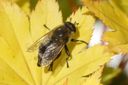
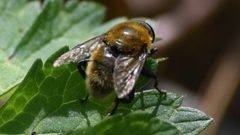
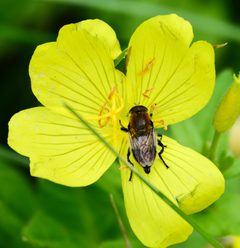
Stout-bodied fly 10–14 mm in length with small . and covered by dense, long, erect hairs of variable coloration (orange, yellow, black combinations). Tergites black without dust spots or blue-purple sheen seen in other Merodon . Hind very strong with large triangular projection on underside near tip—diagnostic for . Males: touching at front; tibiae 3 with 2 spurs. Females: eyes separated by yellow-haired -like structure.
Habitat
Open areas in deciduous forest up to subalpine zone; strongly in suburban parks, gardens, and horticultural land. Associated with ground vegetation and bare ground patches where frequently settle.
Distribution
Holarctic: Palearctic from Fennoscandia south to Iberia and Mediterranean basin, Ireland east through Europe into Russia and Japan. Nearctic from British Columbia south to California. Introduced to New Zealand.
Seasonality
active April through July (Northern Hemisphere). Larvae overwinter within bulbs.
Diet
feed on pollen and nectar from diverse flowers. Larvae feed internally on bulb tissues of Amaryllidaceae and Liliaceae.
Host Associations
- Narcissus - primary most economically significant; derives from this association
- Hyacinthus -
- Tulipa -
- Iris -
- Amaryllis -
- Leucojum -
- Galanthus -
- Lilium -
- Colchicum -
- Scilla -
- Muscari -
- Allium -
- Camassia -
- Erythronium -
- Fritillaria -
- Polygonatum -
- Scadoxus -
- Vallota -
- Zephyranthes -
- Haemanthus -
- Clivia -
- Crinum -
- Hippeastrum -
- Nerine -
- Sprekelia -
- Brunsvigia -
- Cyrtanthus -
- Boophone -
Life Cycle
Complete . laid singly on plant leaves or in adjacent soil. Larvae bore into bulbs, feeding internally on tissues; three larval instars described. Larvae overwinter within bulbs. occurs in spring, with emerging to mate and oviposit. Detailed stages described by Hodson (1932) and illustrated by Rotheray (1993).
Behavior
fly low (near ground vegetation) with fast zig-zag pattern. Frequently settle on bare ground. Bumblebee mimicry serves as evolutionary defense against . Poison- sprays have been used for adult control.
Ecological Role
Herbivore and horticultural pest. Bulb damage can cause plant death or reduced vigor. No known significant ecological role in native ; impact largely confined to anthropogenic environments.
Human Relevance
Major economic pest of cultivated ornamental bulbs, especially Narcissus. Control measures include poison- sprays, soil treatments, and bulb (historically including carbon disulfide). Subject of genetic research on mimetic color . sequenced (Wellcome Open Research 2024).
Similar Taxa
- Merodon flavuscongeneric with overlapping European distribution; discussed in comparative studies of color evolution
- Mallota speciessyrphid bumblebee mimic; distinguished by lacking strong hind with triangular projection
- Arctophila speciessyrphid bumblebee mimic; prefers higher vegetation layers and lacks diagnostic hind leg structure
- Criorhina speciessyrphid bumblebee mimic; separated by preference (higher vegetation) and leg
- Pocota speciessyrphid bumblebee mimic; distinguished by leg structure and height
- Brachypalpus speciessyrphid bumblebee mimic; lacks strong hind characteristic of Merodon
More Details
Genetics
Color controlled by six gene loci: bulborum, U, V, equestris, transversalis, and ground color. Three loci (equestris, bulborum, ground color) show weak linkage. Most common color types are best bumblebee mimics in UK, maintained at high frequency with linkage disequilibrium. number 2n = 12; demonstrated in multiple tissues.
Control History
Subject of intensive agricultural research since early 20th century. 1932 study by Hodson provided foundational data. Multiple control methods developed including cultural practices, chemical treatments, and protocols.
Sources and further reading
- BugGuide
- Wikipedia
- GBIF taxonomy match
- iNaturalist taxon
- NCBI Taxonomy
- Catalogue of Life
- Uncategorized | Blog - Part 4
- Hosts of Merodon equestris Fabr.
- Merodon equestris . [Distribution map].
- The Large Narcissus Fly, Merodon equestris, Fab. (Syrphidae)
- Observations on the Life History of the Narcissus or Daffodil Fly, Merodon Equestris FAB.
- Observations on the Life History, Harits and Control of the Narcissus Bulb Fly Merodon Equestris Fab., in Oregon
- Further Observations on The Life History, Habits, and Control of The Narcissus Bulb Fly, Merodon Equestris, With Data on The Effects of Carbon Disulplhide Fumigation on Three Bulb Pests
- The genetics of mimetic colour polymorphism in the large narcissus bulb fly, Merodon equestris Fab. (Diptera: Syrphidae)
- The genome sequence of a hoverfly, Merodon equestris (Fabricius, 1794).