
Merodon
Meigen, 1803
Species Guides
1- Merodon equestris(Narcissus bulb fly)
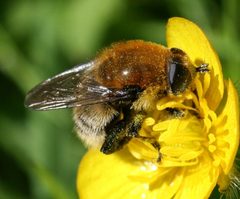
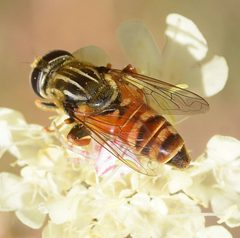
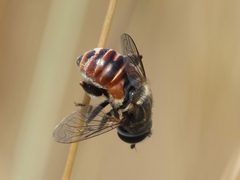
Merodon is a large of -mimicking hoverflies (Syrphidae) and the second largest hoverfly genus in Europe, with over 50 European . The genus exhibits its highest diversity in the Mediterranean region, particularly Turkey where approximately 65 species have been recorded. Worldwide species estimates suggest more than 200 species may exist. are flower-visiting , while larvae are internal feeders on monocot bulbs and rhizomes.
Pronunciation
How to pronounce Merodon: /ˈmɛrəˌdɒn/
These audio files are automatically generated. While they are not always 100% accurate, they are a good starting point.
Identification
resemble bees in general appearance, a trait shared with other -mimicking hoverfly . -level identification requires examination of male terminalia and wing venation patterns. The M. caudatus species group is distinguished by unique metaleg including twisted metatibia and modified metabasotarsomere. Geometric morphometrics of wing shape and COI gene sequences are used for species delimitation in taxonomic revisions.
Images
Habitat
occur in diverse terrestrial across their range. Larval habitat is subterranean, developing within bulbs and rhizomes of plants. Specific habitat associations vary by ; some occupy natural grasslands and open woodlands while others are associated with cultivated settings.
Distribution
Palaearctic and Afrotropical realms. Center of distribution in Turkey (~65 ). European species concentrated in Southern and Eastern Europe. Range extends through the Middle East to Pakistan, and throughout Africa from Morocco and Ghana eastward to South Africa.
Diet
Larvae feed on bulbs and rhizomes of monocotyledonous plants. Merodon equestris larvae specifically consume bulbs of Amaryllidaceae including Narcissus (daffodils), Leucojum aestivum (summer snowflake), and Galanthus nivalis (snowdrop). feed on nectar and pollen.
Host Associations
- Amaryllidaceae - larval food plantbulb for M. equestris including Narcissus, Leucojum aestivum, Galanthus nivalis
- monocotyledons - larval food plantgeneral larval group for
Life Cycle
Holometabolous. Larvae develop internally within plant bulbs or rhizomes, feeding subterraneously. occurs within or near host tissue. emerge to fly and visit flowers.
Behavior
are flower-visiting hoverflies that pollinate while feeding. Larvae are concealed feeders, causing damage to bulbs through internal feeding. in some complicates field identification.
Ecological Role
function as . Larvae act as herbivores of monocot bulbs. Some , particularly M. equestris, are agricultural and horticultural pests of ornamental bulb crops.
Human Relevance
Merodon equestris (Narcissus bulb fly) is a recognized pest of cultivated narcissus and other ornamental Amaryllidaceae. Historical literature incorrectly implicated this as a pest of onion and tulip; these associations have been refuted. The has no known medical or veterinary significance.
Similar Taxa
- EumerusBoth belong to tribe Merodontini and contain -mimicking hoverflies with larvae that feed on bulbs; Eumerus is distinguished by glistering and different wing venation
Misconceptions
Merodon equestris was historically misidentified as a pest of onion and tulip crops. Research has demonstrated this specifically attacks Amaryllidaceae bulbs (Narcissus, Galanthus, Leucojum) and does not infest Allium or Tulipa.
More Details
Taxonomic activity
The has experienced substantial taxonomic revision, with numerous new described in recent decades. Integrative combining , COI sequences, and geometric morphometrics has revealed cryptic , particularly within the M. caudatus and M. ottomanus complexes.
Sources and further reading
- BugGuide
- Wikipedia
- GBIF taxonomy match
- iNaturalist taxon
- NCBI Taxonomy
- Catalogue of Life
- Hosts of Merodon equestris Fabr.
- Déjà Vu in Merodon Taxonomy (Diptera: Syrphidae): Unveiling Hidden Species Inside Merodon caudatus and M. ottomanus Taxa.
- Revision of the Afrotropical endemic Eumerus triangularis group (Diptera: Syrphidae: Merodontini) - Species with glistering antennae.