
Eumerus
Meigen, 1822
Lesser Bulb Flies
Species Guides
1- Eumerus funeralis(Lesser Bulb Fly)
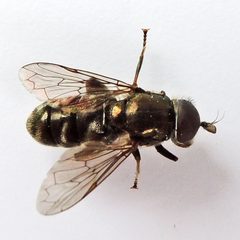
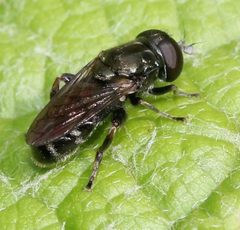
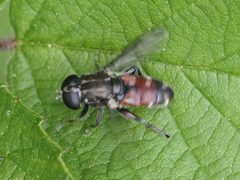
Eumerus is a large of hoverflies ( Syrphidae) comprising approximately 281 . are small to medium (5–12 mm) with distinctive morphological features including a smooth cylindrical , powerful hind legs with thickened , and a flat hairy . The genus is notable for containing several agricultural pests whose larvae damage bulbs and roots of ornamental and crop plants.
Pronunciation
How to pronounce Eumerus: /juːˈmeɪrəs/
These audio files are automatically generated. While they are not always 100% accurate, they are a good starting point.
Identification
Distinguished from other hoverfly by combination of: powerful hind legs with thickened ; flat with downward-directed hairs; reentrant upper crossvein; front cross- with pronounced kink; smooth cylindrical with segmental constrictions. Males have that meet at top of ; females have eyes separated.
Images
Habitat
Open, semi-humid to dry grasslands; open forests and savannas; karoo vegetation and semi-deserts; rocky outcrops with sparse vegetation; urban gardens, parks, and nurseries. Agricultural and horticultural settings where bulb and root crops are grown commercially.
Distribution
Widespread across multiple biogeographic regions: Europe (including Great Britain, Holland); North America (introduced, first recorded 1904); Afrotropical Region ( groups present).
Diet
Larvae feed on bulbs and roots of plants. Specific diet not documented in sources.
Host Associations
- narcissus - larval major commercial pest
- onion - larval also known as "Lunate Onion Fly"
- hyacinth - larval
- parsnip - larval
- iris - larval
- potato - larval
- Aloe species - larval Afrotropical
Life Cycle
Larvae develop within plant bulbs and roots. Specific details of , pupal, and longevity not documented in provided sources.
Behavior
Larvae cause damage to plant bulbs and roots, resulting in serious losses in commercial narcissus . Some regarded as pests in urban gardens, parks, and nurseries. present in some species, complicating sex association.
Ecological Role
Larvae function as plant pests in agricultural and horticultural . role in pollination not explicitly documented in sources.
Human Relevance
Several are significant agricultural and horticultural pests. Larvae cause economically important damage to narcissus, onion, and other bulb crops. Introduced in North America represent European introductions.
Similar Taxa
- Merodon equestrisBoth are syrphid bulb pests; Merodon is larger ("Large Narcissus Fly") and causes similar but more severe damage. Eumerus are smaller with distinctive hind leg .
Sources and further reading
- BugGuide
- Wikipedia
- iNaturalist taxon
- NCBI Taxonomy
- Catalogue of Life
- The Bionomics of the Lesser Bulb Flies, Eumerus strigatus, Flyn., and Eumerus tuberculatus, Rond., in South–west England
- Revision of the Afrotropical endemic Eumerus triangularis group (Diptera: Syrphidae: Merodontini) - Species with glistering antennae.