
Eumerus funeralis
Meigen, 1822
Lesser Bulb Fly
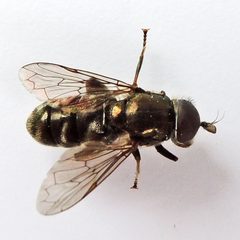
Eumerus funeralis, commonly known as the Lesser Bulb Fly, is a small hoverfly in the Syrphidae. Originally described from the Mediterranean basin, it has become in distribution, particularly widespread in the Palaearctic and Nearctic regions. The is notable for its phytophagous larvae, which develop in damaged bulbs and are recognized as a minor pest of ornamental plants including Narcissus, Hyacinthus, and Amaryllis.
Pronunciation
How to pronounce Eumerus funeralis: /ˈjuːmɛrəs fjʊˈnɛrəlɪs/
These audio files are automatically generated. While they are not always 100% accurate, they are a good starting point.
Identification
Distinguished from related Eumerus by the combination of: dark brown to blackish wing stigma; 3 with small process at base plus bare shiny area; female with large squarish shiny area (not narrowed anteriorly); and entirely blackish tergites lacking red-brown markings. Previously confused with E. strigatus, but reinstated as valid species by Speight et al. (1998).
Images
Appearance
Wing length 3.5–6 mm. Stigma dark brown to blackish. 3 with small process at base, with bare shiny area to this projection. Female with large squarish shiny area occupying entire width except for narrow white dust strips against margin. Tergites blackish without red-brown markings. Male genitalia figured in Van Veen (2004); larva illustrated in Rotheray (1993).
Habitat
Open ground, dry grassland, and clearings in dry woodland. Also occurs in suburban gardens and horticultural land.
Distribution
Originated in Mediterranean basin; now . Widespread in Palaearctic and Nearctic regions. Records from Belgium (Flemish Region, Walloon Region, Brussels-Capital Region).
Seasonality
active April to September, with peaks in June and August.
Diet
visit flowers including Euphorbia, Fragaria, Leucanthemum, and Ranunculus. Larvae phytophagous, feeding in damaged bulbs.
Host Associations
- Narcissus - minor pest — larval in bulbsornamental plant
- Hyacinthus - minor pest — larval in bulbsornamental plant
- Amaryllis - minor pest — larval in bulbsornamental plant
Life Cycle
Larval stage develops within damaged bulbs of plants. Specific details not documented in available sources.
Ecological Role
Minor agricultural pest of ornamental bulb crops. pollination activity at flowers. Larval herbivory in damaged bulb tissue.
Human Relevance
Recognized as minor pest of ornamental bulb plants (Narcissus, Hyacinthus, Amaryllis). No major economic significance reported.
Similar Taxa
- Eumerus strigatus (Fallen)Previously treated as ; distinguished by morphological details of 3 and pattern
- Eumerus tuberculatus RondaniE. funeralis represents the correct name for tuberculatus sensu auctorum, not the true tuberculatus
Misconceptions
E. funeralis was long treated as a synonym of E. strigatus in Peck (1988), but this was taxonomically incorrect. The was reinstated as the valid name for the previously misidentified as tuberculatus Rondani.
Sources and further reading
- BugGuide
- Wikipedia
- GBIF taxonomy match
- iNaturalist taxon
- NCBI Taxonomy
- Catalogue of Life
- Celebrating National Moth Night at the Bohart Museum of Entomology | Bug Squad
- Ready for Moth Night at UC Davis? | Bug Squad
- Bohart Museum Open House: Let's Celebrate Moths! | Bug Squad
- Bug Squad
- Mournful Butterfly | Bug Squad
- Bug Eric: Spring (Butterfly) Beauties