
Eristalis cryptarum
(Fabricius, 1794)
Bog-dwelling Drone Fly, Bog Hoverfly
Eristalis cryptarum is a Holarctic hoverfly specializing in bog and wetland . It is notable for its restricted distribution and significant declines across Europe, with extirpation from much of its former English range and critical endangerment in Denmark. The species exhibits classic Eristalis with distinctive coloration and is a member of the drone fly group, though it is not a mimic to the same degree as some . Its larvae are assumed to be aquatic filter-feeders in saturated peat, though they remain undescribed.
Pronunciation
How to pronounce Eristalis cryptarum: //ˌɛrɪˈsteɪlɪs ˈkrɪptərəm//
These audio files are automatically generated. While they are not always 100% accurate, they are a good starting point.
Identification
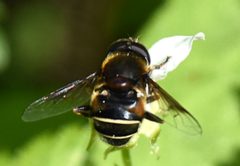
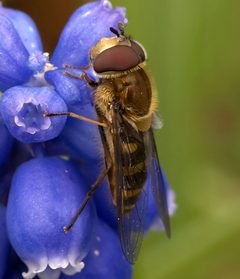
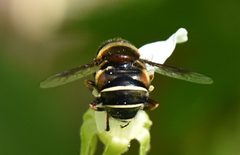
Distinguished from other Eristalis by the combination of: unusually large, bright reddish-orange third antennal joint; abdominal pattern with triangular reddish-orange spots on second segment forming an uninterrupted shining fascia; wholly shining black third and fourth abdominal segments with only yellow hind borders; and black, non-thickened hind . The wing venation with spurious present and characteristic looping of R4+5 into r4+5 is diagnostic for the . The bog preference helps separate it from more widespread like E. tenax. Male genitalia figured by Hippa et al. (2001) provide definitive identification.
Images
Appearance
measure 9–13 mm in length. The female is yellow pilose below, lightly pollinose and clothed with black pile on the sides above; pile is yellowish on front and vertex, black about the ocelli. has black ground color lightly covered with whitish pollen and pile on sides, with a wide black facial stripe on a pronounced . Cheeks are shining black. The unusually large third antennal joint () is bright reddish-orange; bare. are wholly lightly pilose. is dark shining brown with reddish pile on sides. Scutellum is reddish with black pile, reddish along border. : second segment has roughly triangular reddish-orange or brownish red spots extending across between as a shining fascia not interrupted in the middle, with deep opaque black elsewhere and yellow hind border; pile on spots is bright golden red. Third and fourth segments are wholly shining black except yellow hind borders; part of third segment is less distinctly shining, more subopaque. Fifth segment (hypopygium) is wholly shining black with long white pile. Wings are hyaline with black ; portion tinted brown as far as cross-vein and slightly into base of second basal , with brownish band on anterior basal portion. Diagnostic venation: spurious vein present, R4+5 looping into cell r4+5, r2+3; closed cell with anterior cross-vein (r-m) near middle of (dm) oblique. Legs are reddish with black pile; basal part of black, last three tarsal joints black; hind femora black and not thickened; tibiae orange with yellow basally.
Habitat
of oligotrophic bogs, wet heathland, and valley mires. Occurs in peat saturated with water and other wetland . Females have been observed depositing on and close to very fresh cow along oligotrophic seepages in moorland, suggesting this microhabitat is important for .
Distribution
Holarctic distribution spanning central and Northern Europe east to Siberia and Mongolia. In England, formerly occurred in all southwestern counties as far east as the New Forest; range has contracted dramatically since the mid-20th century and now restricted to a few sites on Dartmoor, Devon. In Denmark, considered critically endangered and possibly extinct. Present in Norway and Sweden; records from Flanders, Belgium indicate absence there.
Diet
feed on nectar and pollen from flowers. Larval diet assumed to be filter-feeding on bacteria and microbes in saturated peat, based on , but remains unconfirmed for this .
Life Cycle
Larvae are undescribed. Assumed to be aquatic filter-feeders of the rat-tailed type, breathing through an elongated siphon, based on characteristics. presumably occurs on dry land once larval maturity is reached, as in related . have been observed in cavities around cave mouths and similar sheltered locations.
Behavior
Exhibits hovering typical of Syrphidae. Females deposit on or near fresh cow in specific seepage . engage in in some , utilizing both migration to escape harsh winters and staying put to exploit mild conditions—a strategy observed in Eristalis hoverflies generally.
Ecological Role
contribute to pollination through flower visitation. Larval role in bog remains unstudied but likely involves nutrient cycling in saturated peat. As a bog , serves as an for intact oligotrophic wetland ecosystems.
Human Relevance
Subject to conservation concern due to dramatic declines and range contractions. Serves as an indicator of healthy bog . No known direct economic importance; not a pest or .
Similar Taxa
- Eristalis tenaxCommon drone fly is more widespread, , and strongly mimics honey bees; E. cryptarum has more restricted , larger reddish-orange , and different abdominal pattern.
- Eristalis arbustorumOverlaps in European distribution but differs in antennal coloration and abdominal pattern; E. cryptarum's uninterrupted reddish fascia on second abdominal segment is distinctive.
Sources and further reading
- BugGuide
- Wikipedia
- GBIF taxonomy match
- iNaturalist taxon
- NCBI Taxonomy
- To Bee or Not to Bee | Bug Squad
- A friendlier type of drone: Common Drone Fly, Eristalis tenax — Bug of the Week
- Bug Eric: Fly Day Friday: Rat-tailed Maggots
- The bee’s knees: a new, non-lethal way to study pollinator networks
- Insect Migration (Part 1) - Buglife Blog - Buglife
- Mudo Pryfed (Rhan 1) - Buglife Blog - Buglife