
Sphegina
Meigen, 1822
Pufftails
Species Guides
8- Sphegina biannulata
- Sphegina brachygaster(Thick-waisted Pufftail)
- Sphegina campanulata(Orange-horned Hammertail)
- Sphegina flavimana(Tuberculate Pufftail)
- Sphegina keeniana(Peg-legged Pufftail)
- Sphegina lobata(Yellow-lobed Pufftail)
- Sphegina lobulifera(Black-lobed Pufftail)
- Sphegina rufiventris(Black-horned Pufftail)
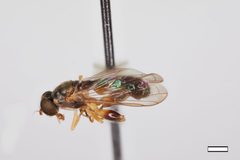
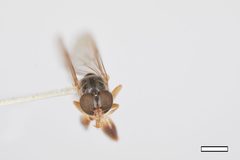
Sphegina is a of small, slender hoverflies (Syrphidae) known as 'pufftails' due to their distinctive appearance in . are widespread across Eurasia and North America, typically found in damp, shaded forest near water. The genus exhibits pronounced in antennal structure and is distinguished from its sister group Neoascia by facial pilosity, katepisternal setation, and antennal proportions. Larvae develop in association with wood-boring insects, utilizing sap flows and decaying cambium in moist conditions.

Pronunciation
How to pronounce Sphegina: //sfɛˈɡiːnə//
These audio files are automatically generated. While they are not always 100% accurate, they are a good starting point.
Identification
Distinguished from sister Neoascia by: oblique and nearly straight (vs. concave), laterally pilose (vs. bare); katepisternum usually pilose (vs. non-pilose); basoflagellomere usually elongate, longer than wide (vs. oval); bare and approximately as long as basoflagellomere (vs. pilose and longer). Small Sphegina closely resemble Neoascia in general habitus and may be difficult to distinguish in field conditions. Two subgenera recognized: Asiosphegina and Sphegina.
Images
Appearance
Small, slender hoverflies with elongated bodies. strongly concave and bare in both sexes; antennal basoflagellomere oval with long pilose . bare and dichoptic. Postpronotum pilose; metasternum and katepisternum non-pilose. scutellar fringe absent. Alula narrow or absent. Postmetacoxal bridge complete and broad. Metaleg much longer than pro- and mesoleg, with incrassate . . In , long hind legs often hang downward, creating -like silhouette.
Habitat
inhabit damp, shady environments in forested areas, typically in close proximity to water sources. Larval are xylobiont: developing in sap flows of living and dead trees, decaying cambium under bark in damp conditions, or within tunnels of other wood-boring insects. Larval divided into main biotope (larval development) and additional biotope ().
Distribution
Widespread throughout Eurasia and North America. European documented with detailed distribution records; presence confirmed in Denmark, Norway, Sweden, and Vermont (USA) among other locations.
Diet
feed on flowers of Apiaceae, Ranunculaceae, Asteraceae, and Rosaceae, including Crataegus, Sorbus, and Sorbaria. Larval diet associated with wood-boring insect ; specific feeding mode not documented.
Host Associations
- xylomycetophagous bark beetles (Coleoptera, Curculionidae, Scolytinae) - larval associationlarvae found in tunnels
- flies of family Axymyiidae - larval associationxylobiont member
- flies of family Syrphidae - larval association or related xylobiont syrphids
- other xylobiont insects - larval associationwood-boring insect tunnels utilized
Life Cycle
Holometabolous. Larval development occurs in main (wood-associated, damp environments). occurs in additional biotope, distinct from larval development site. Specific duration of developmental stages not documented.
Behavior
often found in multi- . In , long hind legs characteristically hang downward, creating resemblance to sphecid or ichneumonid wasps—possible mimicry .
Ecological Role
function as of woodland flowers. Larvae occupy sap flows and decaying cambium, contributing to wood decomposition systems. Associated with xylobiont of ambrosia insects, though specific ecological function within these communities not established.
Human Relevance
Documented in citizen science projects (e.g., City Nature Challenge). No known economic or medical significance.
Similar Taxa
- NeoasciaSister ; distinguished by facial shape, katepisternal pilosity, and antennal proportions. Small especially difficult to separate in field conditions.
More Details
Subgeneric classification
Two subgenera recognized: Asiosphegina and Sphegina.
Taxonomic history
European subject to extensive nomenclatural revision; modern have revised species concepts but often retained predecessor . Multiple synonymies and lectotype designations established in recent taxonomic treatments.
Sources and further reading
- BugGuide
- Wikipedia
- GBIF taxonomy match
- iNaturalist taxon
- NCBI Taxonomy
- Catalogue of Life
- Bug Eric: City Nature Challenge 2023 Recap
- Synopsis of the European species of Sphegina Meigen (Diptera: Syrphidae)
- Habitat Associations of the Larvae of the Genus Sphegina Meigen, 1822 (Diptera, Syrphidae) with Xylobiont Insects