
Sphegina campanulata
Robertson, 1901
Orange-horned Hammertail, Orange-horned Pufftail
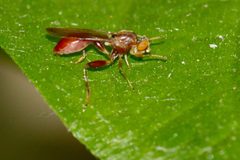
Sphegina campanulata is a syrphid fly (hoverfly) described by Robertson in 1901. It is fairly common in the northeastern United States. The species is known for its distinctive orange-horned appearance and is one of approximately 45 observations documented on iNaturalist. Like other members of the Sphegina, it exhibits the characteristic hovering ability common to syrphid flies.
Pronunciation
How to pronounce Sphegina campanulata: /ˈsfɛɡɪnə ˌkæmpəˈnjuːlətə/
These audio files are automatically generated. While they are not always 100% accurate, they are a good starting point.
Identification
Distinguished from similar Sphegina by the orange-horned referenced in . Separation from other northeastern US syrphid flies requires examination of specific morphological characters not detailed in available sources. The Sphegina is characterized by reduced wing venation and slender body form compared to many other hoverfly genera.
Images
Appearance
have distinctive orange horns, giving rise to both . As a member of Sphegina, it possesses the slender body form and reduced wing venation typical of this genus. The specific epithet 'campanulata' (bell-shaped) may refer to a morphological feature, though this is not explicitly documented in available sources.
Habitat
Associated with woodland environments, particularly damp, shaded areas. Larval specifically includes accumulations of decaying sap under bark in wet situations such as damp woodland and partially submerged wood in streams and pools.
Distribution
Northeastern United States. Documented distribution records include Vermont (US).
Diet
feed on nectar and pollen from flowers. Larval diet consists of decaying sap and associated microorganisms in larval .
Life Cycle
Larvae develop in accumulations of decaying sap under bark, typically in wet woodland situations or partially submerged wood in aquatic environments. stage feeds on flowers. Specific details of and not documented.
Behavior
exhibit hovering capability characteristic of syrphid flies. Adults are commonly found on flowers, where they obtain nectar for energy and pollen for protein.
Ecological Role
function as through flower visitation. Larvae contribute to decomposition processes in decaying sap accumulations and wet wood .
Human Relevance
Contributes to pollination services. No documented negative impacts or economic significance.
Similar Taxa
- Other Sphegina speciesShare -level characteristics of slender body form and reduced wing venation; require detailed morphological examination for separation
- Other Brachyopini tribe membersShare Eristalinae placement and associated morphological features
More Details
Nomenclature note
Catalogue of Life lists this with status 'synonym' under the classification path including 'Sphegina (Asiosphegina) campanulata', while GBIF lists it as 'ACCEPTED'. This indicates taxonomic uncertainty regarding subgeneric placement that does not affect species-level recognition.
Observation frequency
iNaturalist documents approximately 45 observations, indicating it is encountered with moderate frequency by naturalists but is not among the most commonly recorded hoverflies.