
Hermetia
Latreille, 1804
soldier flies
Species Guides
9Hermetia is a of soldier flies in the Stratiomyidae. The genus contains approximately 30 distributed primarily in the Neotropical and Nearctic regions. The most extensively studied species is Hermetia illucens, commonly known as the black soldier fly, which has gained prominence for its applications in waste management and sustainable protein production. are characterized by their -mimicking appearance, with metallic coloration and distinctive wing patterns. Larvae develop in decomposing organic matter including manure, compost, and food waste.
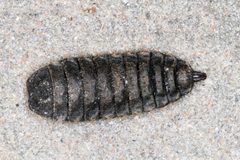
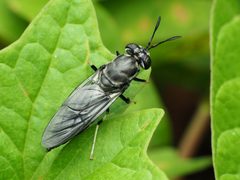
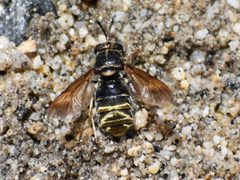
Pronunciation
How to pronounce Hermetia: /hɛrˈmɛti.a/
These audio files are automatically generated. While they are not always 100% accurate, they are a good starting point.
Identification
of Hermetia illucens, the best-known , can be distinguished from similar dipterans by their black bodies with dark wings, metallic reflections from filters in the , and two translucent spots on the first abdominal segments that create the illusion of a narrow -like waist. Adults range from 14-17 mm in length. The wasp-mimicking appearance and movements can cause confusion with mud dauber wasps (Sphecidae), but soldier flies lack a constricted petiole and have only one pair of wings. Larvae are robust, with a darkened capsule and distinct body segmentation; mature larvae reach a substantial size before .
Images
Habitat
Larvae develop in decomposing organic matter including animal manure, compost, food waste, and decaying vegetation. are often attracted to fluorescent lights. The occupies diverse environments from agricultural settings to natural decomposition sites.
Distribution
Primarily distributed in the Neotropical and Nearctic regions. Distribution records from GBIF indicate presence in Norway (NO) and Sweden (SE), suggesting either introduced or data artifacts. The native range centers on the Americas, with Hermetia illucens now widely distributed globally due to human-mediated transport and commercial .
Diet
Larvae feed on decomposing organic matter. Specific dietary components vary by substrate but include decaying plant material, manure, and food waste. do not feed; they rely on larval energy reserves.
Life Cycle
Complete with , larval, pupal, and stages. Larvae pass through multiple instars, with the final instar ceasing feeding to seek sites. Development time varies with temperature and food availability.
Behavior
males exhibit -like mating . Larvae demonstrate high metabolic in converting organic waste into . Adults are and exhibit -mimicking movements. Larvae raised at lower densities develop proportionally larger , indicating developmental plasticity in response to environmental conditions.
Ecological Role
Larvae function as primary decomposers, accelerating breakdown of organic waste. They convert low-value organic matter into high-protein , transferring nutrients up . Their serves as organic fertilizer. In natural systems, larvae support predatory arthropods and other decomposers; provide food for insectivorous birds and other .
Human Relevance
Hermetia illucens is commercially cultivated for animal feed protein, reducing reliance on fish meal and soybeans. Larvae are used in waste management systems for manure and food waste bioconversion. Research indicates potential as a source of antimicrobial effective against Helicobacter pylori. extracted from dead specimens has applications as a biodegradable sorbent. The is not a and does not bite humans.
Similar Taxa
- StratiomysBoth belong to Stratiomyidae and share soldier fly , but Stratiomys typically exhibit more pronounced abdominal color patterns and lack the distinctive translucent abdominal spots of Hermetia illucens.
- Exaireta spinigeraAnother stratiomyid with -mimicking appearance, but Exaireta spinigera has different wing venation and lacks the specific abdominal markings of Hermetia.
Sources and further reading
- BugGuide
- Wikipedia
- GBIF taxonomy match
- iNaturalist taxon
- NCBI Taxonomy
- Catalogue of Life
- A Buggy New Year! | Bug Squad
- ESA Entomology Games Are Both Educational and Entertaining | Bug Squad
- Insect-Based Chicken Feed Can Benefit Farmers and Environment
- Magic of the recycle bin and an edamame surprise: Soldier flies, Stratiomyidae — Bug of the Week
- Inside a Fly Larva's Gut, Microbes Take a Bite Out of Plastic
- Black Soldier Flies Show Potential as Source of Antimicrobial Compounds
- Hermetia illucens en la alimentación de aves Hermetia illucens in poultry feeding.
- Entomo-Industry of Hermetia Illucens
- Production of chitin from dead Hermetia Illucens
- Anatomy, physiology, and behavior of Hermetia illucens
- USING INTACT AND MINCED HERMETIA ILLUCENS LARVAE AS A FODDER IN AQUACULTURE (REVIEW OF FOREIGN LITERATURE)
- Sensory morphology, investment and plasticity in the black soldier fly (Hermetia illucens)
- Ontogenetic Variations in the Sensory Organ Structure and Morphology on the Cephalic Appendages of Hermetia illucens (Diptera: Stratiomyidae) Larvae.