
Inopus
Walker, 1850
sugarcane soldier fly, soldier fly
Species Guides
1- Inopus rubriceps(Sugarcane soldier fly)
Inopus is a of soldier flies in the Stratiomyidae, comprising approximately six described native to Australia. The genus includes economically significant agricultural pests, particularly Inopus rubriceps (sugarcane soldier fly) and Inopus flavus, whose larvae feed on plant roots and cause substantial damage to sugarcane crops and pastures. Larvae develop underground for one to two years, while short-lived do not feed. Several species have been introduced to New Zealand and California, where they continue to impact agricultural systems.
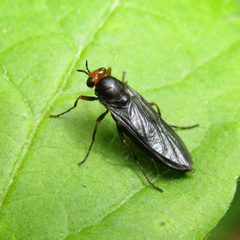
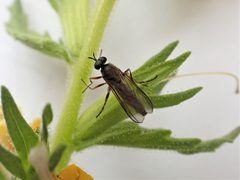
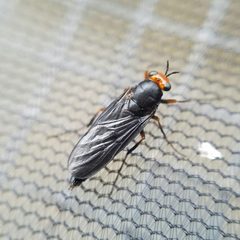
Pronunciation
How to pronounce Inopus: /ˈiː.nə.pʊs/
These audio files are automatically generated. While they are not always 100% accurate, they are a good starting point.
Images
Habitat
Larvae inhabit friable, free-draining soils, typically alluvial or basaltic in origin, in the upper 10 cm of soil profile. Highest larval densities occur within 15 cm of plant bases. Distribution is associated with mean temperatures exceeding 12.8°C and annual rainfall greater than 750 mm in warm temperate regions or 1000 mm in subtropical/tropical regions.
Distribution
Native to Australia, with the geographic center of diversity in southeast Queensland and northern New South Wales. Inopus rubriceps has been introduced to New Zealand and California, USA. Australian are discontinuous, with reproductively isolated populations in eastern and southern regions.
Seasonality
exhibit two main periods per season: November–December and March–April. occurs during autumn, with timing varying by latitude due to soil temperature differences.
Diet
Larvae feed on roots of plants in Gramineae (including sugarcane and sorghum), Cruciferae, Cucurbitaceae (excluding zucchini), Leguminosae, and Solanaceae. Larval growth rates and survival are positively associated with plant root system size. do not feed.
Host Associations
- Saccharum officinarum - pestprimary ; larvae feed on roots causing mechanical and damage
- Sorghum - favorable for larval growth
- Various pasture grasses - significant pest in New Zealand pastures
Life Cycle
duration is 12–24 months, most commonly 24 months. hatch in approximately 2 weeks. Larvae pass through multiple instars over one to two years underground. lasts approximately 1 month and occurs in autumn when soil temperatures reach 20–25°C. live only a few days.
Behavior
Larvae aggregate in clumped distributions near plant bases, actively seeking proximity to roots. Larval occurs through active movement and passive transport in soil adhering to farm machinery. is triggered by rainfall. Adults exhibit activity with measurable vertical distribution patterns.
Ecological Role
Larvae function as root-feeding herbivores that reduce crop yields by 3–8% at densities of 100 larvae per m². Serve as for and viral including dicistroviruses and jingmenviruses. Potential role in virus transmission to host plants has been proposed but remains unconfirmed.
Human Relevance
Major agricultural pest of sugarcane in Australia and pastures in New Zealand. Economic impacts include reduced ratooning, decreased stalk numbers and weights, and yield losses of 1.2–6.4 tonnes cane per hectare per 100 larvae per m². Control challenges stem from subterranean larval , rendering above-ground applications ineffective. Subject of research into viral biocontrol agents.
Similar Taxa
- Stratiomyidae-level distinction; Inopus are distinguished by larval specificity, two-year , and economic impact on monocot crops
- Scarabaeidae (white grubs)larvae occupy similar root-feeding in soil; distinguished by (flies vs. beetles) and taxonomic placement
More Details
Viral associations
Multiple novel viruses have been identified in Inopus flavus larvae through transcriptome analysis, including dicistroviruses, jingmenviruses, anphevirus, orthomyxo-like viruses, narna-like viruses, partiti-like viruses, toti-like viruses, and densoviruses. These discoveries suggest a diverse virome with potential applications for biocontrol, though replication in laboratory models remains inconsistent.
Taxonomic uncertainty
Further study of -level and distributions has been identified as a research priority, with previous work concentrated on the most economically important species, I. rubriceps.
Sources and further reading
- BugGuide
- Wikipedia
- GBIF taxonomy match
- iNaturalist taxon
- NCBI Taxonomy
- Catalogue of Life
- Biology, Dispersion, and Natural Enemies of Inopus rubriceps1
- BIOGEOGRAPHY OF INOPUS RUBRICEPS (MACQUART) (DIPTERA: STRATIOMYIDAE)
- Distribution of Larvae of Inopus rubriceps (Diptera: Stratiomyidae) Around Sugarcane Plants
- Biology, Ecology and Control of Soldier Flies Inopus Spp (Diptera, Stratiomyidae) - a Review
- Discovery of a Novel Jingmenvirus in Australian Sugarcane Soldier Fly (Inopus flavus) Larvae
- Timing of Pupation of Inopus rubriceps (Macquart) (Diptera: Stratiomyidae) in Sugarcane Fields
- Discovery of a novel jingmenvirus in Australian sugarcane Soldier fly ( Inopus flavus ) larvae
- A new Dicistrovirus from soldier fly Inopus flavus (James) (Diptera: Stratiomyidae), a pest of sugarcane
- Aspects of the Flight Behavior of the Grass Roots Fly, Inopus rubriceps (Diptera: Stratiomyidae) 1
- Vertical Flight Distribution of AdultInopus rubriceps, a Pest of Sugarcane in Australia
- Field response of sugarcane cultivars to sugarcane soldier fly, Inopus rubriceps (Macquart) (Diptera: Stratiomyidae)
- GROWTH AND SURVIVAL OF INOPUS RUBRICEPS (MACQUART) (DIPTERA: STRATIOMYIDAE) ON DIFFERENT CROP PLANTS
- Life cycle of the Australian soldier fly, Inopus rubriceps (Diptera: Stratiomyidae), in New Zealand
- Transcriptome Analysis Reveals a Diverse Range of Novel Viruses in Australian Sugarcane Soldier Fly (Inopus flavus) Larvae
- Effects of pasture height on intrapaddock distribution, adult emergence, and adult flight activity of soldier fly ( Inopus rubriceps Macquart: Stratiomviidae)