
Inopus rubriceps
(Macquart, 1847)
Sugarcane soldier fly, Australian soldier fly
Inopus rubriceps is a soldier fly (Stratiomyidae) native to subtropical eastern Australia, where it has a long evolutionary history in Southeast Queensland and northern New South Wales. The has been introduced to New Zealand (first recorded 1944) and California, where it establishes in warm, moist climates. Larvae develop in soil around plant roots, with a typically spanning 24 months but occasionally completing in 12 months. The species is an agricultural pest of sugarcane, pasture, oats, and maize, though not considered major.
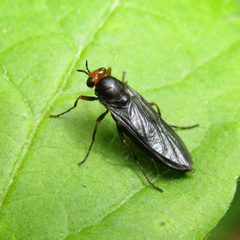
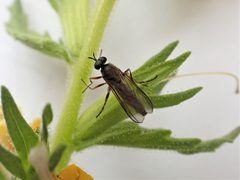
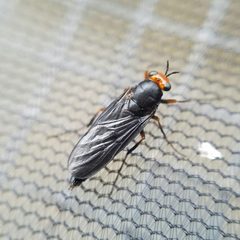
Pronunciation
How to pronounce Inopus rubriceps: /ɪnˈoʊpəs ˈruːbrɪˌsɛps/
These audio files are automatically generated. While they are not always 100% accurate, they are a good starting point.
Identification
Distinguished from other soldier flies by its association with sugarcane and pasture in subtropical regions; have two main periods per season (November–December and March–April in New Zealand). No related Inopus occur in its native Australian range. Specific morphological diagnostic features are not documented in available sources.
Images
Habitat
Warm, moist climates in subtropical and tropical regions; requires mean temperatures above 12.8°C and rainfall exceeding 750 mm/year in warm temperate areas or 1000 mm/year in subtropical/tropical regions. Larvae occur only in friable, free-draining soils, typically alluvial or basaltic in origin. Found in sugarcane fields, pastures, and agricultural soils with favorable plants.
Distribution
Native to Southeast Queensland and northern New South Wales, Australia, where are discontinuous and likely reproductively isolated across eastern and southern Australia. Introduced to New Zealand (first recorded 1944 at Ōpōtiki, Bay of Plenty, North Island) and California, USA.
Seasonality
Two main periods per season: November–December and March–April (documented in New Zealand). occurs during autumn in sugarcane fields, with timing varying by 1 month between northern/central Queensland and southern Queensland/northern New South Wales due to soil temperature differences. Midpoint of pupation coincides with mean soil temperatures of 20–25°C.
Diet
Larvae feed on roots of plants in Gramineae (including sugarcane and sorghum), Cruciferae, Cucurbitaceae (excluding zucchini), Leguminosae, and Solanaceae. Growth is faster on sugarcane, sorghum, legumes, and tomatoes than on crucifers, cucurbits, or capsicums. Plants with larger root systems support better larval growth.
Life Cycle
Complete with variable duration. hatch in approximately 2 weeks under field conditions. Larval stage typically spans 2 years (occasionally 1 year), with larvae classified by weight into under 1 year and over 1 year age classes by September. occurs in autumn and lasts approximately 1 month. live only a few days. The may be completed in 12 months or, more commonly, 24 months.
Behavior
Larvae exhibit specific spatial distribution patterns around sugarcane plants, with densities correlated with total root weights. show activity with documented vertical flight distribution. In pastures, larval and pupal densities and adult activity are greatest over areas of long pasture resulting from selective grazing. is inhibited at 25°C and favored by lower temperatures.
Ecological Role
Agricultural pest causing yield reductions in sugarcane (1.2–6.4 tonnes cane per hectare per 100 larvae per m², or 3–8% yield loss), pasture, oats, and maize. Serves as for Neurogalesus carinatus and Neurogalesus militis. Larval feeding on plant roots impacts crop productivity; levels are influenced by grazing management and soil conditions.
Human Relevance
Economic pest of sugarcane, pasture, oats, and maize. Yield losses documented in sugarcane cultivar trials. Management through grazing intensity manipulation and crop practices; bare between sugarcane crops may reduce larval survival compared to rotations with favorable plants. Not considered a major pest due to limited damage severity.
Sources and further reading
- BugGuide
- Wikipedia
- GBIF taxonomy match
- iNaturalist taxon
- NCBI Taxonomy
- Catalogue of Life
- Meloidae Holdings | Entomology Research Museum
- Distribution of Larvae of Inopus rubriceps (Diptera: Stratiomyidae) Around Sugarcane Plants
- BIOGEOGRAPHY OF INOPUS RUBRICEPS (MACQUART) (DIPTERA: STRATIOMYIDAE)
- Timing of Pupation of Inopus rubriceps (Macquart) (Diptera: Stratiomyidae) in Sugarcane Fields
- GROWTH AND SURVIVAL OF INOPUS RUBRICEPS (MACQUART) (DIPTERA: STRATIOMYIDAE) ON DIFFERENT CROP PLANTS
- Field response of sugarcane cultivars to sugarcane soldier fly, Inopus rubriceps (Macquart) (Diptera: Stratiomyidae)
- Vertical Flight Distribution of AdultInopus rubriceps, a Pest of Sugarcane in Australia
- Aspects of the Flight Behavior of the Grass Roots Fly, Inopus rubriceps (Diptera: Stratiomyidae) 1
- Life cycle of the Australian soldier fly, Inopus rubriceps (Diptera: Stratiomyidae), in New Zealand
- Effects of pasture height on intrapaddock distribution, adult emergence, and adult flight activity of soldier fly ( Inopus rubriceps Macquart: Stratiomviidae)
- AN EXTRACTION METHOD USED TO STUDY VERTICAL AND LATERAL DISTRIBUTION OF SOLDIER FLY INOPUS RUBRICEPS (DIPTERA: STRATIOMYIDAE) IN SUGAR CANE SOIL
- Relationships between grazing animals and populations of the pasture insects Costelytra zealandica (White) and Inopus rubriceps (Macquart)