
Exaireta spinigera
(Wiedemann, 1830)
garden soldier fly, blue soldier fly
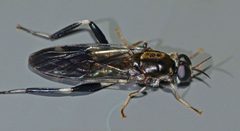
Exaireta spinigera is a soldier fly native to Australia that has been introduced to New Zealand, Hawaii, North America, and Europe. The is recognized by its black body with violet undertones, four yellow-tipped spines on the scutellum, and metallic abdominal sheen. are and active primarily in autumn and spring, with larvae inhabiting decaying organic matter including residential compost. The species has attracted research interest as a potential bioconverter of food waste due to its ability to process organic material at cooler temperatures than the more commonly studied black soldier fly Hermetia illucens.

Pronunciation
How to pronounce Exaireta spinigera: /ɛkˈsaɪərɛtə spɪˈnɪdʒərə/
These audio files are automatically generated. While they are not always 100% accurate, they are a good starting point.
Identification
The combination of four prominent yellow-tipped spines on the scutellum, black body with violet iridescence, and metallic abdominal sheen distinguishes this from other soldier flies. The flattened larval body shape is characteristic of Stratiomyidae but not unique to this species. may be confused with other dark Stratiomyidae, but the scutellar spines are distinctive.
Images
Appearance
are black with violet undertones and shaded wings, measuring 14–16 mm in length. Males are smaller (9–10 mm body, 7–8 mm wings) than females (13–15 mm body, 11–12 mm wings). The is elongated and flattened with a metallic sheen. Four yellow-tipped spines protrude from the scutellum near the . consist of three distinctive segments typical of Stratiomyidae. Larvae are flattened in shape.
Habitat
Larvae inhabit decaying organic matter, particularly residential compost bins and other decomposing substrates. are found hovering near decaying organic material and in residential gardens.
Distribution
Native to Australia. Introduced to New Zealand (both North and South Islands, recorded from Pupuke to Papatowai), Hawaii (first recorded Honolulu 1890s), North America (first recorded Santa Barbara, California 1985), Europe (Italy, France, Belgium, Russia—Black Sea coast at Alder), and Russia.
Seasonality
are with peak activity in autumn (March–May, peaking in April) and spring (September–December). Larvae have been observed in outdoor traps during winter months when Hermetia illucens is inactive.
Diet
Larvae are that consume decaying organic matter and food waste. have been assumed to feed on pollen and nectar, though this has not been confirmed.
Life Cycle
are laid directly into decaying organic substrate. Larvae pupate within the larval skin without external change. Larvae have been observed seeking drier locations to pupate when substrate conditions are too moist, though this has not been directly observed. Specific details on mating behavior and complete duration are unknown.
Behavior
are . Larvae actively process decaying organic material and will relocate to drier conditions for if substrate is excessively moist.
Ecological Role
Larvae function as and decomposers in organic matter breakdown. The serves as prey for various including the German wasp (Vespula germanica), black-headed jumping spider (Trite planiceps), praying mantis nymphs (Miomantis caffra), and the water Dactylosternum abdominale.
Human Relevance
Investigated as a bioconverter for food waste management, with larvae containing 38.6% crude protein even when fed 100% fruit and vegetable waste. Protein content and conversion decrease with low-protein feed, but the remains active at cooler temperatures than Hermetia illucens, offering potential for year-round waste processing in temperate climates. Commonly encountered in residential compost bins.
Similar Taxa
- Hermetia illucensBoth are soldier flies used for food waste bioconversion, but Exaireta spinigera is active at cooler temperatures and has four scutellar spines versus the smooth scutellum of Hermetia illucens.
More Details
Taxonomic history
The was deposited in the Berlin Museum and described when Australia was known as New Holland. The original description requires translation from German using the Fraktur alphabet.