
Hermetia concinna
Williston, 1900
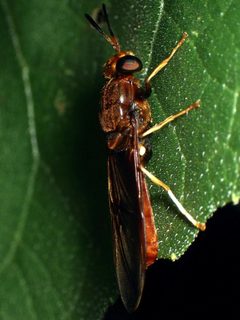
Hermetia concinna is a of soldier fly in the Stratiomyidae, first described by Williston in 1900. It belongs to the same as the well-known black soldier fly (Hermetia illucens), but is a distinct species with a more limited known distribution. The species has been recorded in Mexico and the United States, with 117 observations documented on iNaturalist. Like other members of Stratiomyidae, are likely and associated with decomposing organic matter where larvae develop.
Pronunciation
How to pronounce Hermetia concinna: /hɛrˈme.ti.a kɒnˈkɪn.na/
These audio files are automatically generated. While they are not always 100% accurate, they are a good starting point.
Identification
Hermetia concinna can be distinguished from the more common Hermetia illucens by subtle morphological differences, though specific diagnostic features for this are not well documented in available sources. in the Hermetia typically have black bodies with dark wings, metallic reflections in the due to filters, and two translucent spots on the first abdominal segment that create a -like waist appearance. Accurate identification to species level likely requires examination of genitalia or other fine structural characters.
Images
Distribution
Recorded from Mexico and the United States. Specific preferences within this range are not documented.
Similar Taxa
- Hermetia illucensConvergent black soldier fly with similar -mimicking appearance, but distinguished by distribution (Hermetia illucens is and widely commercialized) and subtle morphological differences; Hermetia concinna has a more restricted range in Mexico and the southern United States
More Details
Taxonomic note
Hermetia concinna is one of approximately 27 in the Hermetia. The genus is best known for H. illucens, which has been extensively studied for waste management, animal feed production, and antimicrobial compound extraction. H. concinna has received minimal research attention by comparison.
Observation data
As of the data cutoff, iNaturalist records 117 research-grade observations of H. concinna, indicating it is encountered with moderate frequency but is far less commonly reported than H. illucens.
Sources and further reading
- BugGuide
- Wikipedia
- GBIF taxonomy match
- iNaturalist taxon
- Catalogue of Life
- A Buggy New Year! | Bug Squad
- ESA Entomology Games Are Both Educational and Entertaining | Bug Squad
- Insect-Based Chicken Feed Can Benefit Farmers and Environment
- Magic of the recycle bin and an edamame surprise: Soldier flies, Stratiomyidae — Bug of the Week
- Inside a Fly Larva's Gut, Microbes Take a Bite Out of Plastic
- Black Soldier Flies Show Potential as Source of Antimicrobial Compounds