
Dalmanniinae
Genus Guides
1Dalmanniinae is a of thick-headed flies ( Conopidae) within the order Diptera. Members of this subfamily are distinguished from other conopids by specific morphological features of the and wing venation. The subfamily contains such as Dalmannia and Zodion, which are primarily found in the Holarctic region. These flies are , with larvae developing within the bodies of Hymenoptera .

Pronunciation
How to pronounce Dalmanniinae: /dælˈmæniː.aɪniː/
These audio files are automatically generated. While they are not always 100% accurate, they are a good starting point.
Identification
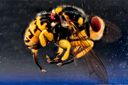
Dalmanniinae can be distinguished from other Conopidae by the following features: capsule often with prominent facial swelling; with bare or shortly pubescent; wing with specific venation patterns including reduced anal lobe and characteristic bend in R4+5; body generally more robust than Stylogasterinae. The Dalmannia is recognized by its large size and distinctive head shape, while Zodion are smaller with more slender bodies.
Images
Distribution
The Dalmanniinae has a primarily Holarctic distribution, with recorded from North America, Europe, and Asia. Records from iNaturalist indicate observations across temperate regions of North America and Europe.
Seasonality
activity has been observed primarily during the warmer months, with peak records from late spring through summer (May–August in temperate regions).
Host Associations
- Hymenoptera - Larvae are endoparasitoids of bees and , including members of Apidae, Vespidae, and Sphecidae. The female fly deposits larvae directly onto foraging or injects them into the host body.
Life Cycle
Females are known to attack Hymenoptera in , depositing larvae that penetrate the host's body wall. Larval development occurs within the living host, eventually killing it. takes place in the soil after the host dies. The complete from to spans approximately one year in temperate .
Behavior
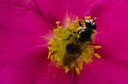
have been observed hovering near flowers and nesting sites. Females exhibit aggressive pursuit , actively chasing potential hymenopteran hosts in to deposit larvae. Males are often found perching on vegetation, awaiting females.
Ecological Role
As of bees and , Dalmanniinae function as regulators of Hymenoptera. They may exert on foraging and nesting strategies. Their role in pollination networks is indirect, as visit flowers primarily for nectar.
Human Relevance
Some parasitize beneficial such as honey bees and bumble bees, potentially impacting local pollinator . They are occasionally cited in studies of health and pressure in agricultural settings.
Similar Taxa
- ConopinaeThe other major of Conopidae; distinguished by differences in , particularly the degree of facial swelling and the structure of the occiput, as well as differences in larval associations.
- StylogasterinaeDistinguished by the highly modified female with an extremely long, rigid ovipositor used to harpoon , a feature absent in Dalmanniinae.
More Details
Taxonomic History
The has undergone taxonomic revision, with some former reassigned based on phylogenetic analysis. The current circumscription follows Stuke (2012) and subsequent molecular studies.
Host Specificity
While generally considered of Hymenoptera, the degree of specificity varies among . Zodion appear more generalized, while Dalmannia shows preference for larger vespid and sphecid .