
Dalmannia
Robineau-Desvoidy, 1830
Species Guides
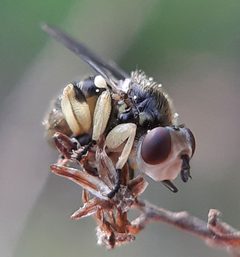
4Dalmannia is a of thick-headed flies ( Conopidae) established by Robineau-Desvoidy in 1830. The genus contains at least 11 described distributed across the Holarctic region, with records from Europe and North America. Members of this genus are flies whose larvae develop within other insects.

Pronunciation
How to pronounce Dalmannia: //dælmˈæn.i.ə//
These audio files are automatically generated. While they are not always 100% accurate, they are a good starting point.
Identification
within Dalmannia can be distinguished by features of the and thoracic bristles, though specific diagnostic characters vary among species. The is placed in Dalmaniinae based on morphological characteristics of the head capsule and wing venation. Detailed species-level identification requires examination of male genitalia and specific bristle patterns.
Images
Distribution
Recorded from Europe (Denmark, Norway, Sweden) and North America (United States, including Vermont).
Life Cycle
As members of Conopidae, Dalmannia have larvae that develop within insects. are free-living and do not feed on the host directly.
Ecological Role
of other insects, contributing to of .
Similar Taxa
- ConopsBoth are in Conopidae with similar general body plan; Dalmannia is distinguished by placement in Dalmaniinae versus Conopinae for Conops.
- PhysocephalaAnother conopid with enlarged ; Dalmannia differs in classification and specific head .
More Details
Taxonomic history
The was established by Robineau-Desvoidy in 1830 and has remained in Conopidae throughout its taxonomic history. The Dalmaniinae was erected to accommodate this and related genera based on derived morphological features.