
Physocephala furcillata
(Williston, 1882)
thick-headed fly
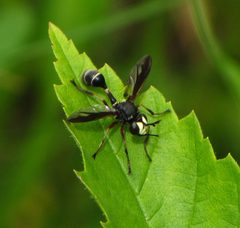
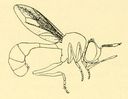
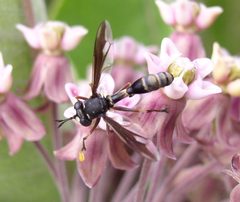
Physocephala furcillata is a of thick-headed fly in the Conopidae. Like other members of its , it is a that attacks bees and in mid-air, forcibly depositing between the 's abdominal segments. The resulting larvae develop internally, typically killing the host within 10–12 days. The species exhibits wasp mimicry, with an elongated and pigmented wing margins that resemble the folded wings of potter wasps.
Pronunciation
How to pronounce Physocephala furcillata: //faɪsoʊˈsɛfələ fɜːrˈsɪlətə//
These audio files are automatically generated. While they are not always 100% accurate, they are a good starting point.
Identification
Distinguished from other Physocephala by specific structural characters of the male terminalia (furcillata refers to forked claspers). Separated from Physoconops by wing venation and shape. Distinguished from true potter wasps by single pair of wings ( Diptera), large that often meet at top of head, and short . Zodion are smaller (5–7 mm) with different body proportions.
Images
Habitat
Associated with flowering where bees and forage. Specific microhabitat preferences not documented.
Distribution
Recorded from Vermont and other parts of United States. Distribution details sparse; likely overlaps with and ranges in eastern and central North America.
Seasonality
activity period not specifically documented. Related emerge in summer; likely in northern range, possibly multivoltine in southern climates.
Diet
feed on nectar. Larvae are internal of Hymenoptera, feeding on tissues.
Host Associations
- bees - Specific unknown for this ; attack bumble bees (Bombus) and other bees
- wasps - Specific unknown; attack solitary including sand wasps (Bembix)
Life Cycle
Females intercept bees or in , forcibly ovipositing between abdominal tergites. Larvae develop internally, consuming host tissues. Host death typically occurs in 10–12 days. Larva pupates within hollow host . the following summer in temperate regions; possibly multiple annually in warmer areas.
Behavior
visit flowers for nectar. Females exhibit aggressive -seeking , actively pursuing bees and in mid-air to force oviposition. Males likely perch or patrol flowers awaiting females.
Ecological Role
of pollinating Hymenoptera; regulator of bees and . Flower visitation contributes to pollination, though ecological significance minor compared to parasitoid impact on populations.
Human Relevance
No direct economic importance. potential limited by specificity and low . Subject of ecological interest for -host dynamics and mimicry evolution.
Similar Taxa
- Physocephala tibialisSimilar -mimicking appearance and ; distinguished by male genitalia and geographic distribution
- Physocephala texanaKnown of sand wasps; P. furcillata distinguished by structural characters
- Physoconops spp.Similar conopid mimics; separated by wing venation, shape, and abdominal structure
- Zodion spp.Smaller conopids (5–7 mm vs. 12–15 mm) with different body proportions; also parasitize
- Eumeninae (potter wasps)Visual mimic; distinguished by two pairs of wings, elbowed , and different structure
More Details
Etymology
Specific epithet 'furcillata' refers to the forked male claspers (furcilla = small fork), a diagnostic morphological feature.
Research needs
records, geographic range, and seasonal require documentation. No published studies specifically address this ' .