
Geomyza
Fallén, 1810
frit flies
Species Guides
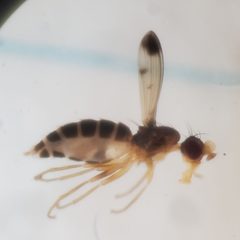
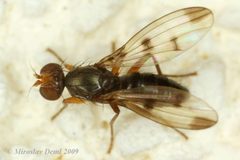
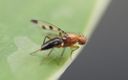
3Geomyza is a of frit flies in the Opomyzidae, comprising at least 30 described . The genus includes economically significant agricultural pests, notably Geomyza tripunctata, whose larvae feed internally on grasses and cereals, killing the central shoot. These flies are distributed across the Holarctic region, with documented occurrences in Europe and North America. Larvae serve as for hymenopterous in grassland .
Pronunciation
How to pronounce Geomyza: //dʒiːəˈmaɪzə//
These audio files are automatically generated. While they are not always 100% accurate, they are a good starting point.
Images
Habitat
Grassland ; agricultural fields containing cereals and grasses. Larval development occurs within plants, particularly ryegrass (Lolium perenne) and Italian ryegrass (L. italicum).
Distribution
Holarctic distribution. Documented from Denmark, Norway, Sweden, and the United States (Vermont). Study records confirm presence in northern England (West Yorkshire).
Seasonality
Larval stage active during autumn through winter months, with occurring between mid-February and early March. monitoring studies conducted October through April indicate this seasonal window encompasses the primary larval activity period.
Diet
Larvae feed internally within grass stems, consuming central shoot tissue. Primary plants in the field are Lolium perenne and L. italicum; wheat and other grasses are attacked under laboratory conditions.
Host Associations
- Lolium perenne - larval plantprimary field
- Lolium italicum - larval plantprimary field
- Triticum - larval plantattacked in laboratory; cereal crop
- Chasmodon apterus - hymenopterous ; in parasitoid complex
- Halticoptera circulus - hymenopterous
- Hexacola hexatoma - hymenopterous
- Opius - hymenopterous
- Rhoptromeris heptoma - hymenopterous
Life Cycle
Complete . Larval development occurs within grass stems during autumn-winter period. begins mid-February to early March. Significant larval mortality occurs during autumn-winter, with -dependent factors implicated in .
Behavior
Larval observed in small- patches within grass fields. Aggregation patterns described by negative binomial distribution, likely resulting from heterogeneous Poisson sampling and true contagion mechanisms.
Ecological Role
Agricultural pest in grassland and cereal crops; larval feeding kills central shoots of grasses. Serves as host for hymenopterous , contributing to natural enemy in agricultural .
Human Relevance
Economic pest of grasses and cereals, causing shoot death similar to damage by . Subject of applied entomological research regarding and potential through .
Similar Taxa
- OscinellaBoth are commonly referred to as 'frit flies' and share similar larval —internal feeding in grass stems that kills the central shoot. Frequently studied together in agricultural pest management research; distinguished by -level classification (Chloropidae vs. Opomyzidae) and subtle morphological differences in flies.
- Oscinella fritSpecific comparison for damage ; both produce identical feeding damage pattern of central shoot death in grasses and cereals. Geomyza tripunctata damage explicitly noted as similar to that caused by O. frit.
More Details
Parasitism Ecology
Geomyza tripunctata serves as for at least five hymenopterous in northern English grasslands. rates range from 3.9% to 56.4% depending on year and experimental conditions, with inverse -dependence observed in field .
Population Dynamics
Autumn-winter larval mortality is substantial and -dependent, with 45-73% of October larval lost by December/January across study years. This mortality factor remains unidentified but represents a significant population regulatory mechanism.
Sources and further reading
- BugGuide
- Wikipedia
- GBIF taxonomy match
- iNaturalist taxon
- NCBI Taxonomy
- Catalogue of Life
- Autumn‐winter mortality of frit fly larvae (Oscinella spp. and Geomyza tripunctata Fall.) in grassland in northern England
- Parasitism of frit fly (Oscinella spp. [Dipt., Chloropidae] and Geomyza tripunctata Fall. [Dipt., Opomyzidae]) by hymenopterous parasitoids in grassland in northern England
- Aggregation of frit fly larvae (Oscinella spp. and Geomyza tripunctata Fall.) and immature hymenopterous parasitoids in grassland in northern England
- ON THE BIONOMICS AND STRUCTURE OF SOME DIPTEROUS LARVAE INFESTING CEREALS AND GRASSES