
Oscinella
Becker, 1909
frit flies
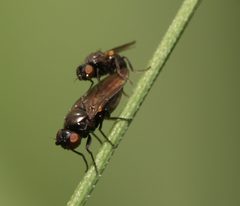
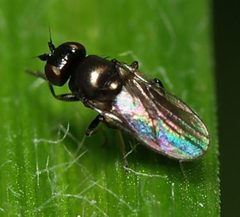
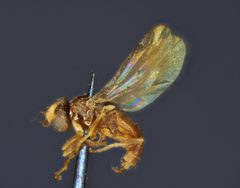
Oscinella is a of small flies in the Chloropidae, commonly known as frit flies. The genus contains multiple , several of which are significant agricultural pests of cereal crops and pasture grasses. The most economically important species is O. frit, which attacks oats, wheat, and other cereals. Species within the genus exhibit distinct and plant preferences, with some being migratory and others sedentary.
Pronunciation
How to pronounce Oscinella: /ˌɔsɪˈnɛlə/
These audio files are automatically generated. While they are not always 100% accurate, they are a good starting point.
Identification
Small flies in the Chloropidae. -level identification within Oscinella requires examination of genitalia and other microscopic characters; external alone is generally insufficient for reliable determination.
Images
Habitat
Agricultural fields, grasslands, and pastures. Specific associations include oat crops, ryegrass (Lolium perenne), and various other Poaceae.
Distribution
Europe, Asia, North America, Central America, Caribbean, Africa, and Oceania. Records include: Europe (widespread including UK, Denmark, Germany, France, Russia), Asia (Afghanistan, India, Kazakhstan, Korea, Malaysia, Mongolia, Nepal, Pakistan, Turkey, Indonesia/Java), North America (Canada, USA, Mexico), Africa (Tunisia), and Oceania (Australia).
Seasonality
Varies by . O. frit exhibits three annually in UK: Generation III (late April–mid June, peak ~May 26), Generation I (late May–mid August, peak ~July 15), Generation II (late July–early September, peak ~August 19). O. nitidissima and O. nigerrima have two generations; O. maura has one generation. O. nigerrima is the earliest species to appear in spring, followed by O. frit and O. nitidissima; O. hortensis, O. vastator, and O. maura emerge later and dominate trap catches in July.
Diet
Larvae feed internally on plant tissues of Poaceae (grasses and cereals). O. frit larvae feed on oats, wheat, Lolium multiflorum, Festuca rubra, and other grasses. O. vastator feeds on Lolium perenne, L. multiflorum, and Festuca pratensis. O. nitidissima primarily feeds on Agrostis tenuis. O. nigerrima feeds on Arrhenatherum elatius. O. albiseta feeds on Dactylis glomerata.
Host Associations
- Poaceae (grasses and cereals) - primary plants for larval developmentOviposition and larval feeding occur within grass stems and leaf
- oats (Avena sativa) - for O. fritmajor economic ; laid inside coleoptile of seedlings
- perennial ryegrass (Lolium perenne) - for O. vastator and O. frit6-year-old crops can support large O. vastator
- Rhoptromeris eucera (Cynipidae) - predominant of O. frit in UK; attacks larval stage, emerges from
- Halticoptera fuscicornis (Chalcididae) - predominant of O. frit in UK
- Loxotropa tritoma (Proctotrupidae) - lower parasitization rates on O. frit
- Callitula bicolor (Chalcididae) - first recorded from O. frit; also reared from associated Chloropids in North America
- Hexacola sp. - described from O. frit in Ontario, Canada
- Polyscelis sp. - described from O. frit in Ontario, Canada
- Cyrtogaster sp. - of O. frit in Ontario
- Spalangia drosophilae - candidate for introduction to UK
- Tylenchoid nematode - sterilizes O. frit; worms develop from larval to adult stage within fly, become , exit via
Life Cycle
Holometabolous. Larvae develop internally within grass stems. O. frit has three per year in UK; O. nitidissima and O. nigerrima have two generations; O. maura has one generation. Partial second or third generations may occur depending on conditions. Larvae pupate within plant tissues; emerge to mate and oviposit. attack the larval stage and emerge from host .
Behavior
differs markedly among . O. frit flies at all heights (0–40 cm) and regularly takes off, making it migratory and capable of invading crops. O. vastator and O. pusilla are primarily stationary within vegetation, rarely flying above crop level; they build large in crops over multiple . of all species are captured in grassland water traps before appearing in suction traps, suggesting initial near ground level. Oviposition occurs inside withered leaf on grasses and inside the coleoptile on oats; on Lolium multiflorum and Agrostis tenuis, are distributed differently than on oats.
Ecological Role
Herbivore of grasses and cereals. for diverse including cynipids, chalcids, proctotrupids, and , contributing to natural . Subject to -dependent that increases seasonally. influence the structure of agricultural and grassland .
Human Relevance
Several are significant agricultural pests. O. frit is a major pest of oats and wheat, causing damage to seedlings and reducing yields. Control is difficult due to extended oviposition periods and internal feeding habit of larvae. Water trap catches may be unreliable for monitoring in crops due to sedentary of some species. introductions have been considered for .
Similar Taxa
- Hippelatesalso Chloropidae; both contain small grass-associated flies, but Hippelates are frequently attracted to decaying animal matter and have different elevational distributions
- MeromyzaChloropidae associated with grasses; distinguished by morphological characters and associations
Sources and further reading
- BugGuide
- Wikipedia
- GBIF taxonomy match
- iNaturalist taxon
- NCBI Taxonomy
- Catalogue of Life
- Oscinella frit . [Distribution map].
- Observations on some Parasites of Oscinella frit Linn. Part II.
- Frit Fly Oscinella frit Oviposition on Oat Seedlings: Ecological Significance of the Host Plant Selection
- On the Nematode Parasite of the frit-fly, Oscinella frit, L
- Observations on some Parasites ofOscinella fritLinn
- Vast ranges of some Oscinella species (Diptera: Chloropidae)
- Observations on the oviposition behaviour of Frit Fly(Oscinella frit L.Dipt. Chloropidae)
- Biology and Ecology of Oscinella Fusidentata Cherian (Diptera : Chloropidae) with Notes on the External Morphology of the Immature Stages
- Parasites of the Frit-fly,Oscinella frit(L.), in eastern North America
- The Jamaican Species ofHippelatesandOscinella(Diptera, Chloropidae)
- Host plan preferences of Oscinella spp. (Diptera: Chloropidae) in the laboratory
- The phenology of Oscinella spp. (Diptera: Chloropidae)
- FURTHER OBSERVATIONS ON THE PREVALENCE AND HABITS OF OSCINELLA FRIT, LINN.
- Differential flight behaviour of Oscinella spp. (Diptera, Chloropidae)
- ADDITIONAL HOST PLANTS OF OSCINELLA FRIT, LINN. AMONG GRASSES.