
Meromyza
Meigen, 1830
grass flies, frit flies
Species Guides
2- Meromyza americana(Wheat Stem Maggot)
- Meromyza communis
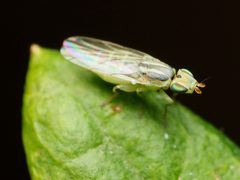
Meromyza is a of grass flies (Diptera: Chloropidae) distributed across the Palaearctic, Nearctic, and parts of Asia including China and Mongolia. within this genus are primarily associated with grasses (Poaceae), with many developing on wild grass species and several recognized as pests of cereal crops including wheat, barley, and oats. The genus exhibits varying degrees of plant specialization, from oligophagous species with broad grass host ranges to monophagous . Larvae are stem-borers that feed internally on host plant tissues, with some species causing economically significant damage to small grains.
Pronunciation
How to pronounce Meromyza: //ˌmɛrəˈmaɪzə//
These audio files are automatically generated. While they are not always 100% accurate, they are a good starting point.
Identification
Meromyza are small flies in the Chloropidae, typically distinguished from other chloropid by morphological features of the male genitalia, particularly the shape and area of the processes of the postgonites. The genus includes species with varying external morphological characters; taxonomic identification relies on detailed examination of 14 external key features combined with male genitalic structures. Species-level identification requires specialized keys and examination of .
Images
Habitat
Grasslands, coastal , and agro- including cultivated cereal fields, field boundaries, and hayfields. In agricultural settings, are found in wheat, barley, rye, and oat fields, often with highest abundance in areas adjacent to wild grass . Cereal height influences local abundance and diversity patterns. Biotopes are typically dominated by single species.
Distribution
Palaearctic region (Europe, Russia including Vologda oblast, Armenia, Finland, Karelia, Kola Peninsula), Nearctic region, China (including Gansu and Ningxia provinces), and Mongolia. GBIF records confirm presence in Denmark, Norway, and Sweden. Distribution patterns reflect association with grass biomes and agricultural cereal .
Seasonality
and activity varies by and . Second-generation adults of some species emerge in spring. In Mongolia, M. acuminata dominates wheat fields by early July. Activity periods correspond to plant growth stages, with larval feeding during stem elongation and grain development.
Diet
Larval feeding is endophytic, with maggots tunneling in grass stems. Larvae feed on stem tissues just above the last stem joint, cutting flow of moisture and nutrients to the . Specific dietary details beyond stem tissue consumption are not documented.
Host Associations
- Poeae (grass tribe) - development 11 of 25 analyzed Western Palaearctic develop on grasses from this tribe
- Triticeae (grass tribe) - development 4 of 25 analyzed Western Palaearctic develop on grasses from this tribe
- Bromeae (grass tribe) - development part of broad spectrum for ancestral-type
- Nardeae (grass tribe) - development part of broad spectrum for ancestral-type
- Arundinarieae (grass tribe) - development one develops on bamboo
- Triticum (wheat) - pest M. americana, M. acuminata, M. nigriventris, M. variegata, and others damage cereal cultivars
- Hordeum (barley) - pest documented for multiple pest
- Secale (rye) - pest documented for multiple pest
- Avena (oats) - pest documented for wheat stem maggot and related
- Agropyron sp. - wild development M. acuminata develops on this wild grass and migrates to cereal crops
Life Cycle
Holometabolous with complete . lay on leaves of grasses. Larvae (maggots) develop internally in stems, feeding on stem tissues. occurs within the stem or in soil. Some exhibit multiple annually; second-generation adults emerge in spring. Specific developmental durations and stages vary by species and climate.
Behavior
Females oviposit on leaves of grasses. Larvae tunnel in stems, causing characteristic white in cereals that are easily pulled from the plant. Some exhibit migratory from wild grass hosts to cultivated cereals; M. acuminata in Mongolia employs the same strategy as M. nigriventris in Europe. Single species typically dominate local . Cereal in agro- results in shifts in .
Ecological Role
Primary consumers as stem-boring herbivores on grasses. Some function as pests in agricultural , reducing grain yield and quality. Larval tunneling alters nutrient flow in plants. Species with narrow host ranges may influence grass composition; broad oligophagous species serve as general consumers across grass .
Human Relevance
Several are recognized pests of small grain cereals. The wheat stem maggot (Meromyza americana) causes white in wheat, barley, oats, and rye by larval feeding; however, infested tillers rarely exceed 1% and treatments are rarely necessary. M. acuminata, M. nigriventris, M. nigriseta, M. variegata, and M. grandifemoris damage cereal cultivars. Economic impact includes reduced germination, kernel weight, and grain quality. Management relies on monitoring rather than routine chemical control.
Similar Taxa
- ChloropsBoth are in Chloropidae with grass-associated ; distinguished by morphological features of male genitalia and external key characters
- OscinellaAnother chloropid containing frit fly pests of cereals; Meromyza distinguished by stem-boring larval habit versus leaf-mining in some Oscinella
More Details
Host Plant Specialization Patterns
Meromyza exhibits a spectrum of specialization from non-specialized oligophages to narrow oligophages and monophages. close to ancestral haplotypes (M. nigriseta, M. pratorum, M. saltatrix, M. variegata) show wide host plant spectra. Speciation within the has been driven by to different wild grasses, with narrow oligophagy and monophagy representing derived states. The divergence of Meromyza species occurred after the diversification of Pooideae grasses in the Miocene.
Morphological Evolution
The process of the postgonite, a male genitalic structure critical for restricting interspecies mating, shows significant evolutionary trends in size among studied . This structure serves as a key diagnostic feature for species identification and phylogenetic analysis. External morphological features and genitalic structures together enable high- species classification (99% using probabilistic neural network analysis).
Sources and further reading
- BugGuide
- Wikipedia
- GBIF taxonomy match
- iNaturalist taxon
- NCBI Taxonomy
- Catalogue of Life
- Occasional Pests - AgriLife Extension Entomology
- Distribution of Meromyza flies (Diptera: Chloropidae) in the cereal crops of Mongolia
- Distribution of frit flies (Chloropidae: Meromyza Mg.) in Vologda oblast and East Poland
- Review of the genus <i>Meromyza</i> from China (Diptera: Chloropidae)
- The role of plants in the formation of species-specific features in grass flies (Diptera, Chloropidae, Meromyza)
- Grassflies of genus Meromyza (Diptera, Chloropidae) and grasses: the evolution of host plant preference
- New data on the distribution of flies of the genus Meromyza (Diptera, Chloropidae) on the territory of European part of Russia and Armenia
- Grassflies of the subfamily Chloropinae, except the tribe Chloropini and the genus Meromyza, of Finland, Karelia and the Kola Peninsula (Diptera, Cyclorrhapha, Chloropidae)
- A review of the grassflies of the genus Meromyza Meigen, 1830 (Diptera, Chloropidae) of the Palaearctic fauna, with a key to the species, analysis of synonymy, host specialization, and geographical distribution: Part 1
- A review of grassflies of the genus Meromyza Meigen, 1830 (Diptera, Chloropidae) of the palaearctic fauna with a key to species, analysis of the synonymy, host specialization, and geographic distribution. Part 2