
Chlorops
Meigen, 1830
grass flies, frit flies
Species Guides
5Chlorops is a of small flies in the Chloropidae, commonly known as grass flies or frit flies. Several are significant agricultural pests of cereal crops. Chlorops oryzae (rice stem maggot) is a major pest of rice in Asia, causing 20-50% yield losses by larval feeding on developing leaves and young panicles. Chlorops taeniopus (gout fly) and related species damage barley and wheat in Europe. The genus exhibits geographic variation in voltinism, with some producing 2-5 annually depending on latitude and patterns.
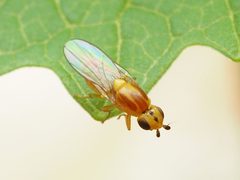

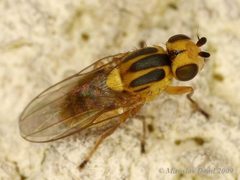
Pronunciation
How to pronounce Chlorops: //ˈklɔːrɒps//
These audio files are automatically generated. While they are not always 100% accurate, they are a good starting point.
Identification
Small size (2-5 mm) and reduced wing venation distinguish Chlorops from larger dipteran . Within Chloropidae, identification requires examination of male genitalia and detailed pattern of and thoracic markings. C. oryzae can be distinguished from related grass flies by association with rice and geographic distribution in Asia. C. taeniopus and C. pumilionis are distinguished by host preference (barley vs. wheat) and subtle morphological differences in genitalia.
Images
Appearance
Small to minute flies, typically 2-5 mm in length. Body generally yellowish to greenish with dark markings. with large and short bearing . Wings clear or faintly tinged, with reduced venation characteristic of Chloropidae. Larvae are maggot-like, pale, and adapted for boring into plant stems.
Habitat
Agricultural , particularly cereal crop fields. Associated with cultivated grasses including rice, barley, wheat, and oats. Some utilize wild grasses as alternate , particularly for .
Distribution
Widespread across temperate and tropical regions. Europe (including Scandinavia: Denmark, Norway, Sweden), Asia (China, Japan, Korea, and other rice-growing regions), and Nearctic region. Distribution records for individual vary; C. oryzae is restricted to Asian rice-growing areas while C. taeniopus and C. pumilionis occur in Europe.
Seasonality
Activity patterns vary by and latitude. In temperate regions, are active during spring and summer growing seasons. C. oryzae produces 2-5 annually depending on region and induction. in northern Japan (39°N) versus trivoltine ecotypes in southern Japan (35°N). Winter diapause occurs in larval stage.
Host Associations
- Oryza sativa - primary Rice; larvae bore into stems and feed on developing leaves and young panicles. C. oryzae specific.
- Hordeum vulgare - primary Barley; causes 'gout' deformities. C. taeniopus and related .
- Triticum aestivum - Wheat; secondary for some . C. pumilionis and occasionally C. taeniopus.
- Agropyron repens - winter Couch grass; utilized by of C. taeniopus.
Life Cycle
Complete with , larva, pupa, and stages. Eggs laid on plants. Larvae bore into stems and feed internally on growing points. occurs within host tissue or in soil. Voltinism varies geographically: to pentavoltine patterns reported, with regulating number. Summer diapause in mature larvae and winter diapause in first larval stage have been documented in C. oryzae.
Behavior
are active in bright, sunny conditions; -laying is stimulated by favorable weather. Females may lay approximately 150 eggs. Multiple matings may be required for full . Larvae exhibit endophytic feeding , boring into stems and moving to growing points, which renders chemical control ineffective. Some show significant enabling rapid geographic expansion and local formation.
Ecological Role
Major agricultural pest causing significant economic losses in cereal production. C. oryzae causes 20-50% yield losses in affected rice regions. Larval feeding disrupts normal plant development, causing 'gout' deformities in barley and stem damage in rice. Serves as for including Stenomalus micans (Pteromalidae) and Coelineus niger (Braconidae), which can achieve high rates (up to 68% in severe years).
Human Relevance
Significant pest of cereal crops requiring integrated management strategies. Control measures include early sowing of spring barley, optimal soil cultural conditions, and strategic (superphosphate stimulates growth and reduces ; nitrogen effects are dose-dependent). Chemical control is often ineffective due to larval endophytic feeding habit. genetic monitoring has been proposed for prediction and management strategy .
Similar Taxa
- MeromyzaRelated chloropid with similar and grass-associated ; distinguished by genitalic and chaetotaxy details
- OscinellaAnother chloropid containing frit fly pests of cereals; generally darker and with different wing venation patterns
- HydrelliaDipteran pests of rice in different (Ephydridae); larvae are leaf miners rather than stem borers
More Details
Photoperiodic Diapause Control
Geographic of C. oryzae show genetically based differences in photoperiodic response. Northern (Akita, 39°N) enter summer under L15:D9, while southern trivoltine populations (Aichi, 35°N) enter summer diapause under L14:D10. A major gene on the exerts primary control over summer diapause induction. Critical for winter diapause induction and diapause duration also differ between ecotypes, controlled by sex-linked or closely linked genes.
Population Genetics and Outbreak Dynamics
Chinese of C. oryzae show higher haplotype diversity and lower diversity, indicating rapid expansion following a bottleneck effect. Frequent (Nm: 2.23-3.60) among populations with low to medium genetic differentiation (Fst: 0.065-0.183) facilitates rapid local . No significant isolation by distance detected.
Sources and further reading
- BugGuide
- Wikipedia
- GBIF taxonomy match
- iNaturalist taxon
- NCBI Taxonomy
- Catalogue of Life
- Population Genetic Structure of Chlorops oryzae (Diptera, Chloropidae) in China
- ON CHLOROPS TAENIOPUS MEIG. (THE GOUT FLY OF BARLEY)
- Distribution and Effects of Chemical Control of Gout Fly (Chlorops Pumilionis Bjerk.) on Spring Wheat in South-Eastern Poland
- Genetic basis of photoperiodic control of summer and winter diapause in geographic ecotypes of the rice stem maggot, Chlorops oryzae
- Effects of temperature and winter diapause on survival and development in bivoltine and trivoltine ecotypes of the rice stem maggot, Chlorops oryzae Matsumura (Diptera : Chloropidae), reared on a winter host
- The Larval and Pupal Anatomy ofStenomalus micansOl. (Pteromalidae), a Chalcid Endoparasite of the Gout-fly of Barley (Chlorops taeniopus Meig.), with some Details of the Life History of the Summer Generation
- Ecology on the Larval Growth of Summer Generations of Rice Stem Maggot, Chlorops oryzae MATSUMURA, in Takada Province
- 39. On the Larval Anatomy of the Gout‐Fly of Barley (Chlorops teniopus Meig.) and two Related Acalyptrate Muscids, with Notes on their Winter Host‐Plants.
- The Distribution of the Wheat Yellow Fly, <I>Chlorops mugivora</I> NISHIJIMA et KANMIYA, in the Tohoku Area, Japan
- Ecology on the Larval Growth of Summer Generations of Rice Stem Maggot, Chlorops oryzae MATSUMURA, in Takada Province
- The Relation between the Larval Growth of the Rice Stem Maggot, Chlorops oryzae MATSUMURA, and the Stages of the Host Rice Plant