
Geomyza tripunctata
Fallén, 1823
Cereal Fly
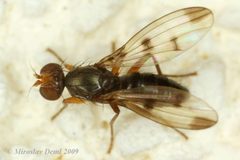
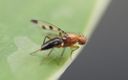
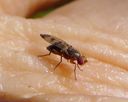
Geomyza tripunctata is a small fly in the Opomyzidae, commonly known as the Cereal Fly. It is distributed across the Palearctic region from Europe to Siberia, with records extending to North Africa. The is associated with grassland and cereal agriculture, where larvae develop as stem borers in grasses and cereals.
Pronunciation
How to pronounce Geomyza tripunctata: /ˈɡeɪ.əˌmaɪ.zə trɪˌpʌŋkˈteɪ.tə/
These audio files are automatically generated. While they are not always 100% accurate, they are a good starting point.
Identification
Small opomyzid fly; specific diagnostic features not documented in available sources.
Images
Habitat
Grassland and cereal fields. Found in agricultural settings and natural grassland .
Distribution
Palearctic region: Europe (common throughout), Norway, Lapland, Siberia, Algeria, Tunisia. Recorded up to 2,300 m elevation. Present in Belgium, Denmark, Norway, Portugal (Madeira).
Seasonality
activity from May to November.
Diet
Larvae feed inside stems of grasses and cereals, killing the central shoot. In the field, chief larval plants are Lolium perenne and L. italicum; in laboratory conditions, other grasses and wheat are readily attacked.
Life Cycle
Larvae tunnel in stems of grasses and cereals. Larval densities decline significantly from October through winter, with commencing between mid-February and early March.
Behavior
Larvae aggregate in patches on a small within grassland. Larval is described by the negative binomial distribution and likely results from heterogeneous Poisson sampling and true contagion (preference for favorable oviposition sites).
Ecological Role
Pest of cereal crops and grasses. for hymenopterous including Chasmodon apterus, Halticoptera circulus, Hexacola hexatoma, Opius , and Rhoptromeris heptoma. levels in G. tripunctata ranged from 3.9% to 56.4% in field studies.
Human Relevance
Agricultural pest affecting cereal production. Larval feeding damages cereal crops by killing central shoots, similar to damage caused by .
Similar Taxa
- Oscinella fritSimilar damage pattern to cereals; both are frit flies with larvae that kill central shoots of grasses. G. tripunctata distinguished by Opomyzidae versus Chloropidae.
- Oscinella spp.Co-occurs in grassland and shares ; distinguished by -level and specific plant associations.
More Details
Parasitoid pressure
Chasmodon apterus dominated the complex in northern England studies, accounting for 40-90% of parasitoids across three years (1984-1986). was inversely -dependent in whole grass fields.
Mortality factors
Autumn-winter mortality significantly reduces larval ; 45-73% of October larval numbers lost by December/January, possibly due to unidentified -dependent mortality factors.
Sources and further reading
- BugGuide
- Wikipedia
- GBIF taxonomy match
- iNaturalist taxon
- NCBI Taxonomy
- Catalogue of Life
- Amazing Story About What Entomologist Lynn Kimsey Recorded in San Francisco Bay 50 Years Ago | Bug Squad
- Beautiful box of Buprestidae | Beetles In The Bush
- Autumn‐winter mortality of frit fly larvae (Oscinella spp. and Geomyza tripunctata Fall.) in grassland in northern England
- Aggregation of frit fly larvae (Oscinella spp. and Geomyza tripunctata Fall.) and immature hymenopterous parasitoids in grassland in northern England
- Parasitism of frit fly (Oscinella spp. [Dipt., Chloropidae] and Geomyza tripunctata Fall. [Dipt., Opomyzidae]) by hymenopterous parasitoids in grassland in northern England
- ON THE BIONOMICS AND STRUCTURE OF SOME DIPTEROUS LARVAE INFESTING CEREALS AND GRASSES