
Phytomyza ilicis
Curtis, 1846
holly leaf miner, European Holly Leafminer
Phytomyza ilicis is a small agromyzid fly whose larvae create distinctive pale leaf mines in European holly (Ilex aquifolium). Native to Europe, it has been introduced to western North America where it became a significant pest of ornamental holly. The is , with highly synchronized : emerge in late spring to oviposit into the soft tissue of newly expanding leaves, and larvae feed internally until completing development the following spring. It has been extensively studied as a model system for understanding , , and multi-trophic interactions including and .
Pronunciation
How to pronounce Phytomyza ilicis: /faɪˈtɒmɪzə ɪˈlaɪsɪs/
These audio files are automatically generated. While they are not always 100% accurate, they are a good starting point.
Identification
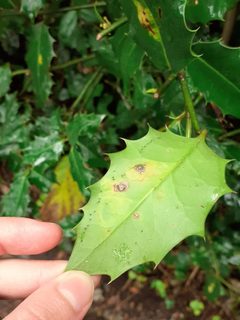
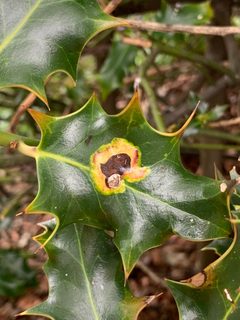
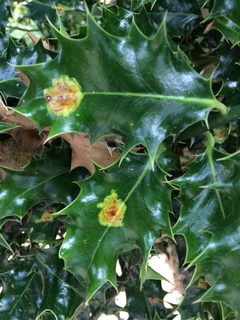
Distinguished from the native North American holly leafminer Phytomyza ilicicola by association (P. ilicis on Ilex aquifolium, P. ilicicola on Ilex opaca/American holly) and geographic range. Leaf mines appear as pale, sinuous trails or blotches on upper leaf surface, typically with a single mine per leaf due to . Exit holes from are >1 mm in diameter, larger than emergence holes. Oviposition scars on petiole or basal midrib distinguish it from other leaf damage.
Images
Habitat
Woodlands, suburban areas, and ornamental plantings where European holly (Ilex aquifolium) occurs. Within plants, larvae occupy the internal leaf tissue between upper and lower , initially tunneling in the midrib before entering the leaf blade around January. Oviposition requires young, soft leaves during the flush period; leaf toughness prevents -laying in mature foliage.
Distribution
Native to Europe, where it is common and widespread. Introduced to western British Columbia, Canada, and the northwestern United States. Distribution limited by temperature: absent where mean temperatures of coldest months fall below −0.5°C. Present in Belgium, Denmark, and other European countries based on occurrence records.
Seasonality
with highly constrained . occurs late May to June, synchronized with holly leaf flush. Oviposition restricted to April–May when new leaves unfold and remain soft enough for ovipositor penetration. Larval feeding continues through winter on warm days, with mine formation visible from January onward. occurs in spring, completing the cycle.
Diet
Larvae feed on internal leaf tissue of European holly (Ilex aquifolium), creating mines between the upper and lower leaf surfaces. feed on sap exuded from feeding punctures made by the ovipositor in leaf tissue.
Host Associations
- Ilex aquifolium - obligate plantEuropean holly; sole for larval development
Life Cycle
Holometabolous with complete . deposited in petiole or basal midrib of young leaves using ovipositor. Larva hatches and tunnels within midrib toward leaf tip, entering leaf blade around January to create visible mine. Development completes in spring with within the leaf mine. emerges through >1 mm exit hole cut in leaf . Maximum eggs per leaf: five, with typically ≤2 larvae surviving to maturity due to and mortality factors.
Behavior
Oviposition tightly constrained by plant : females must locate and penetrate soft, newly expanding leaves during brief spring window. Larval feeding creates characteristic serpentine to blotch-shaped mines. make feeding punctures with ovipositor to access sap. Strong -dependent regulation through in leaf midrib, typically resulting in single mine per leaf regardless of number.
Ecological Role
herbivore forming part of complex centered on holly. Serves as for diverse including Chalcididae and Braconidae. Subject to by blue tits (Parus caeruleus) which tear leaves to access larvae. Vacated mines provide microhabitat for unicellular and mites. Mined leaves are more likely to be abscised by host plant, representing an induced defense.
Human Relevance
Significant economic pest of ornamental holly in western North America, reducing aesthetic and commercial value of cut foliage; 75–80% of leaves may be attacked in infested areas. Subject of programs using imported European . Used extensively in ecological research as a model system for studying , , edge effects, and tri-trophic interactions. generally ineffective due to protected feeding location within leaves.
Similar Taxa
- Phytomyza ilicicolaNative North American on American holly (Ilex opaca); similar leaf-mining habit but distinct association and geographic range. Both have been used to study competitive interactions and host-specificity.
- Phytomyza gymnostomaAllium leafminer; congeneric with similar leaf-mining but on completely different (Alliaceae vs. Aquifoliaceae), allowing comparison of host specialization patterns within the .
More Details
Population regulation
-dependent processes strongly regulate . in the leaf midrib causes pre-mine mortality, typically limiting leaves to single mines regardless of load. Mean survival rates below 10% due to combined effects of competition, , , and other mortality factors.
Edge effects
In suburban woodlands, leafminer is higher and lower at woodland edges compared to interiors. Mechanisms involve interactions between microclimate, movement patterns, and -plant quality, with natural enemies contributing differentially to mortality at edge vs. interior locations.
Biological control history
Introduced to western Canada without natural enemies, prompting efforts. Multiple imported from Europe 1936–1938, including Chrysocharis gemma and Opius ilicis. Chrysocharis gemma became parasitoid on Vancouver Island (~90% ), while Opius ilicis predominated on mainland (~90% parasitism), demonstrating spatial variation in agent efficacy.
Sources and further reading
- BugGuide
- Wikipedia
- GBIF taxonomy match
- iNaturalist taxon
- NCBI Taxonomy
- Catalogue of Life
- The Holly and Ivy - A two part series: This week the holly and the native holly leaf miner, Phytomyza ilicicola — Bug of the Week
- Deck the halls with boughs of holly…and the Native holly leafminer, 'Phytomyza ilicicola', and Holly berry midge, 'Asphondylia ilicicola' — Bug of the Week
- Invasive Fly Targets North American Onions, Leeks, Related Crops
- urbanization | Blog
- How One Entomologist Became a Detective of 'Pest Mysteries'
- Spain | Blog
- The Holly Leaf-miner (Phytomyza ilicis, Curt.) and its Parasites
- Bottom‐up density regulation in the holly leaf‐miner Phytomyza ilicis
- The biology and post-embryonic development ofOpius ilicisn.sp., a parasite of the holly leaf-miner (Phytomyza ilicisCurt.)
- Edge effects on the prevalence and mortality factors of Phytomyza ilicis (Diptera, Agromyzidae) in a suburban woodland